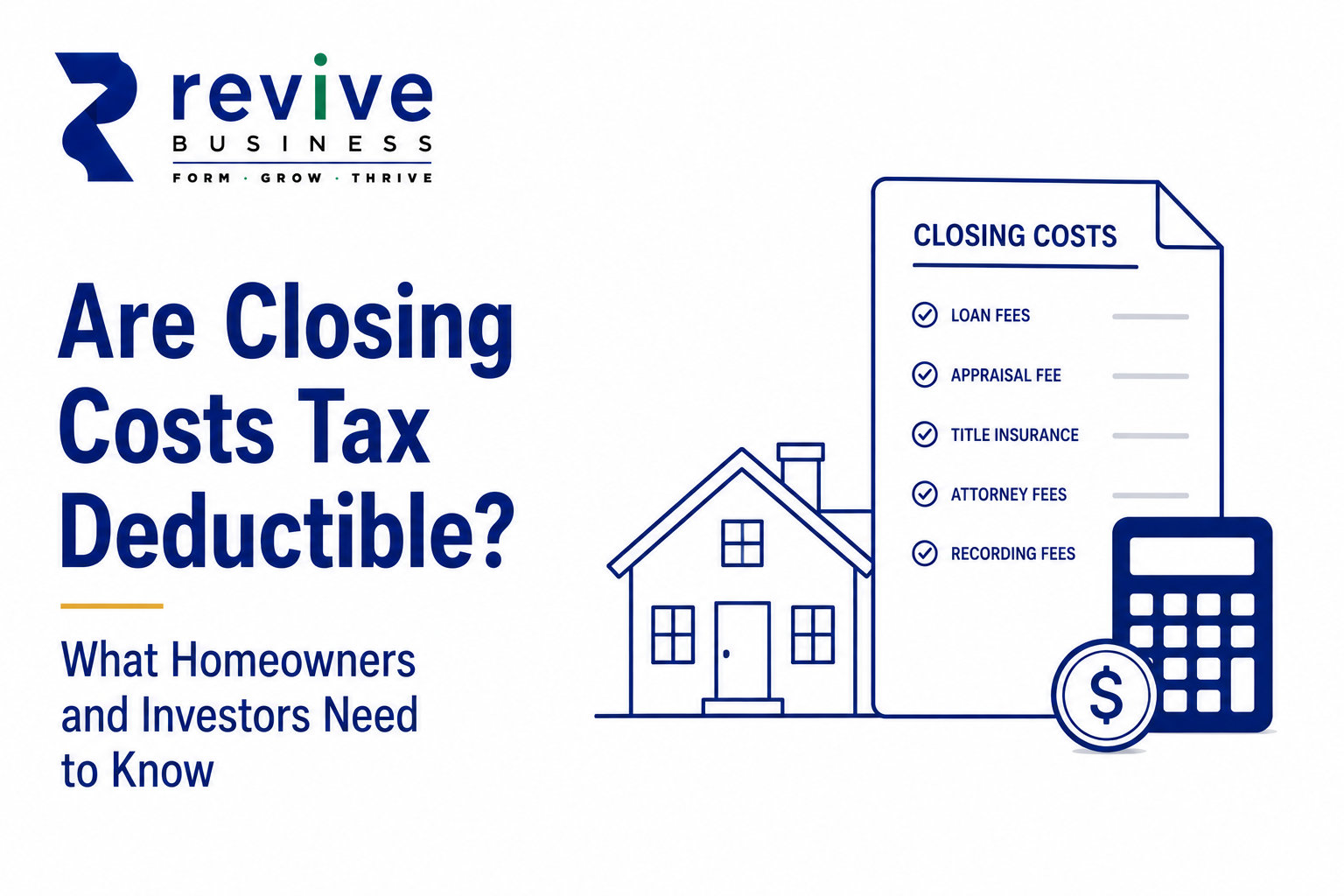
Are Closing Costs Tax Deductible? What Homeowners and Investors Need to Know
Are closing costs tax deductible? Learn which costs qualify, which do not, and how the rules differ for homeowners, rental property owners, and business buyers.
Closing costs add up fast. On a median-priced home purchase in the United States, buyers typically pay between 2% and 5% of the purchase price in closing costs before they ever make a mortgage payment. On a $400,000 home, that is $8,000 to $20,000 in upfront costs that many buyers wonder if they can recover at tax time.
The honest answer is that most closing costs are not tax deductible for personal home purchases, but the rules change significantly depending on whether the property is a primary residence, a rental investment, or a business property. Getting this wrong means either missing legitimate deductions or claiming deductions you are not entitled to, both of which create problems down the road.
This guide breaks down exactly which closing costs are deductible, which are not, how the treatment differs by property type, and what documentation you need to support your position if your return is ever reviewed.
What Are Closing Costs?
Closing costs are the fees and expenses paid at the settlement of a real estate transaction, beyond the actual purchase price of the property. They are paid by both buyers and sellers, though the specific costs each party bears depend on the contract terms, local customs, and state law.
Common closing costs for buyers include loan origination fees, discount points, appraisal fees, title search and title insurance fees, attorney fees, recording fees, transfer taxes, prepaid property taxes, prepaid homeowners insurance, and prepaid mortgage interest. Each of these has a different tax treatment, and lumping them together as a single closing cost figure is one of the most common mistakes taxpayers make when trying to determine what is deductible.
Closing Costs That Are Tax Deductible for a Primary Residence
For most homeowners purchasing a primary residence, only a small subset of closing costs qualifies for a tax deduction in the year of purchase. The IRS does not allow a general deduction for the cost of acquiring a home, but it does allow deductions for specific items that would be deductible in any year they are paid.
Mortgage Interest Prepaid at Closing
Any prepaid mortgage interest paid at closing is deductible in the year it is paid, provided you itemize deductions on your federal return. This interest typically covers the period from your closing date to the end of that calendar month and appears on your Closing Disclosure as a prepaid item. You will also receive a Form 1098 from your lender that includes this amount, making it straightforward to report correctly.
Discount Points
Discount points paid to reduce your mortgage interest rate can be deductible in the year of purchase if certain IRS conditions are met. The loan must be secured by your primary residence, the points must be a percentage of the loan amount, and paying points must be an established practice in your geographic area. If all conditions are satisfied, the points are deductible as mortgage interest in the year paid. Points paid on a refinance or for a second home are generally deducted over the life of the loan rather than all at once.
Property Taxes Prepaid at Closing
If you prepay property taxes at closing that cover the current tax year, that amount may be deductible subject to the State and Local Tax deduction cap. Under current tax law, the SALT deduction is capped at $10,000 per year for married filing jointly and $5,000 for married filing separately. If your total state and local taxes already exceed this cap, additional prepaid property taxes at closing will not provide any further tax benefit.
Closing Costs That Are Not Deductible for a Primary Residence
The majority of closing costs for a primary home purchase are not deductible in the year of purchase. This includes appraisal fees, title search fees, title insurance premiums, attorney fees, recording fees, transfer taxes, home inspection fees, survey fees, and loan origination fees other than points. These costs are considered part of the cost basis of the property rather than current-year deductions.
Adding these costs to your property's cost basis is not meaningless, however. A higher cost basis reduces the taxable gain when you eventually sell the property. If you paid $12,000 in non-deductible closing costs on a home you later sell for a profit, those $12,000 reduce the gain subject to capital gains tax. Keeping detailed records of every closing cost paid is therefore important even when no immediate deduction is available.
Closing Costs for Rental Properties: A Different Set of Rules
The tax treatment of closing costs changes substantially when the property being purchased is a rental investment rather than a primary residence. Rental properties are treated as business assets under the tax code, which opens up deduction opportunities that are not available to homeowners.
Most closing costs on a rental property purchase are not immediately deductible either, but they are added to the depreciable cost basis of the property. This means they are recovered over time through annual depreciation deductions rather than as a lump-sum deduction in the year of purchase. Residential rental property is depreciated over 27.5 years under the IRS modified accelerated cost recovery system, so the closing costs get folded into that depreciation schedule.
Prepaid mortgage interest and property taxes paid at closing on a rental property are currently deductible in the year paid as rental expenses, reported on Schedule E. Loan origination fees that qualify as points on a rental property are deducted over the life of the loan rather than all in the year of purchase.
One important distinction for rental property owners is that operating expenses incurred after the property is placed in service are currently deductible, while costs incurred before the property is ready to rent are capitalized and depreciated. Understanding exactly when a property is considered placed in service affects how you categorize certain pre-rental expenses.
Closing Costs When Selling a Property
When you sell a property, the closing costs you pay as a seller are treated differently from the closing costs you paid as a buyer. Seller closing costs, which typically include real estate agent commissions, transfer taxes, title fees, and attorney fees, are not deducted as current-year expenses. Instead, they reduce the amount realized from the sale, which directly reduces your taxable gain.
For example, if you sell a home for $500,000 and pay $30,000 in seller closing costs, your amount realized is $470,000. Your taxable gain is calculated based on $470,000 minus your adjusted cost basis, not the full $500,000 sale price. Keeping documentation of all seller closing costs is essential for accurate gain calculation, particularly if the property has appreciated significantly.
Business Property Purchases and Closing Costs
When a business or LLC purchases commercial real estate or other business property, closing costs are generally added to the cost basis of the asset and recovered through depreciation over the applicable IRS recovery period. Commercial real estate is depreciated over 39 years, while certain improvements may qualify for shorter recovery periods or bonus depreciation.
Some business property closing costs may qualify for immediate expensing under Section 179 or bonus depreciation rules depending on the nature of the asset and the applicable tax year. These provisions have changed frequently in recent years, and the specific rules for your purchase year should be verified before filing. An error in categorizing business property closing costs can affect multiple years of depreciation deductions and create discrepancies that surface during an audit.
Documentation You Need to Support Closing Cost Deductions
Regardless of which closing costs you are deducting or adding to your cost basis, documentation is essential. The IRS requires substantiation for every deduction, and real estate transactions generate a significant paper trail that you need to preserve.
Your Closing Disclosure or HUD-1 Settlement Statement is the primary document that itemizes every cost paid at closing. Keep this document permanently, not just for the current tax year. If you ever sell the property and need to calculate your adjusted cost basis, the original closing statement from the purchase is one of the most important documents you can have. Store it in multiple locations including a digital backup.
For rental property owners, maintain a separate file for each property that includes the original purchase Closing Disclosure, all subsequent improvement receipts, annual depreciation schedules, and any sale-related closing documents. This organizational structure makes tax preparation significantly more straightforward and provides clear documentation if any deductions are questioned.
Frequently Asked Questions
Can I deduct all closing costs in the year I purchase a home?
No. For a primary residence, only prepaid mortgage interest, qualifying discount points, and prepaid property taxes are deductible in the year of purchase, and only if you itemize deductions. All other closing costs are added to your cost basis and are not currently deductible.
Are title insurance and appraisal fees deductible?
Not as a current-year deduction for a primary home purchase. These costs are added to your cost basis and help reduce your taxable gain when you eventually sell the property. For a rental property, they are added to the depreciable cost basis and recovered through annual depreciation deductions.
Are closing costs deductible if I refinance my mortgage?
Most closing costs on a refinance are not immediately deductible. Points paid on a refinance are deducted over the life of the new loan rather than all in the year paid. Prepaid interest covering the period from closing to the end of that month is deductible in the year paid. If you refinance a rental property, the rules differ and more costs may be deductible.
Does adding closing costs to my cost basis actually save me money?
Yes, it can. A higher cost basis means a lower taxable gain when you sell. If you are in the 15% capital gains tax bracket and paid $15,000 in closing costs that increased your basis, those costs could save you $2,250 in capital gains tax at the time of sale. The benefit is deferred rather than immediate, which is why many taxpayers underestimate its value.
Are closing costs on a rental property fully deductible in year one?
Most are not. The majority of closing costs on a rental property are added to the depreciable cost basis and recovered over 27.5 years through annual depreciation. Prepaid interest and property taxes paid at closing are currently deductible as rental expenses in the year paid, reported on Schedule E.
Need Help Reporting Closing Costs Correctly on Your Tax Return?
Closing cost tax treatment is one of the areas where small errors create problems that accumulate over time. Misclassifying a cost that should be added to your basis as a current deduction, or missing a legitimate deduction because you did not realize it qualified, both affect multiple years of tax filings. Getting it right in the year of purchase is far easier than correcting it later.
At Revive Business, our tax return filing services help homeowners, rental property investors, and business owners report real estate transactions accurately, capture every legitimate deduction, and maintain the documentation needed to support their position. Reach out to the team at Revive Business today and let us make sure your closing costs are handled correctly from day one.