Best State to Form an LLC in 2026: An Honest Comparison for Small Business Owners
Comparing the best states to form an LLC in 2026. Wyoming, Delaware, and your home state compared on fees, privacy, taxes, and registered agent rules.
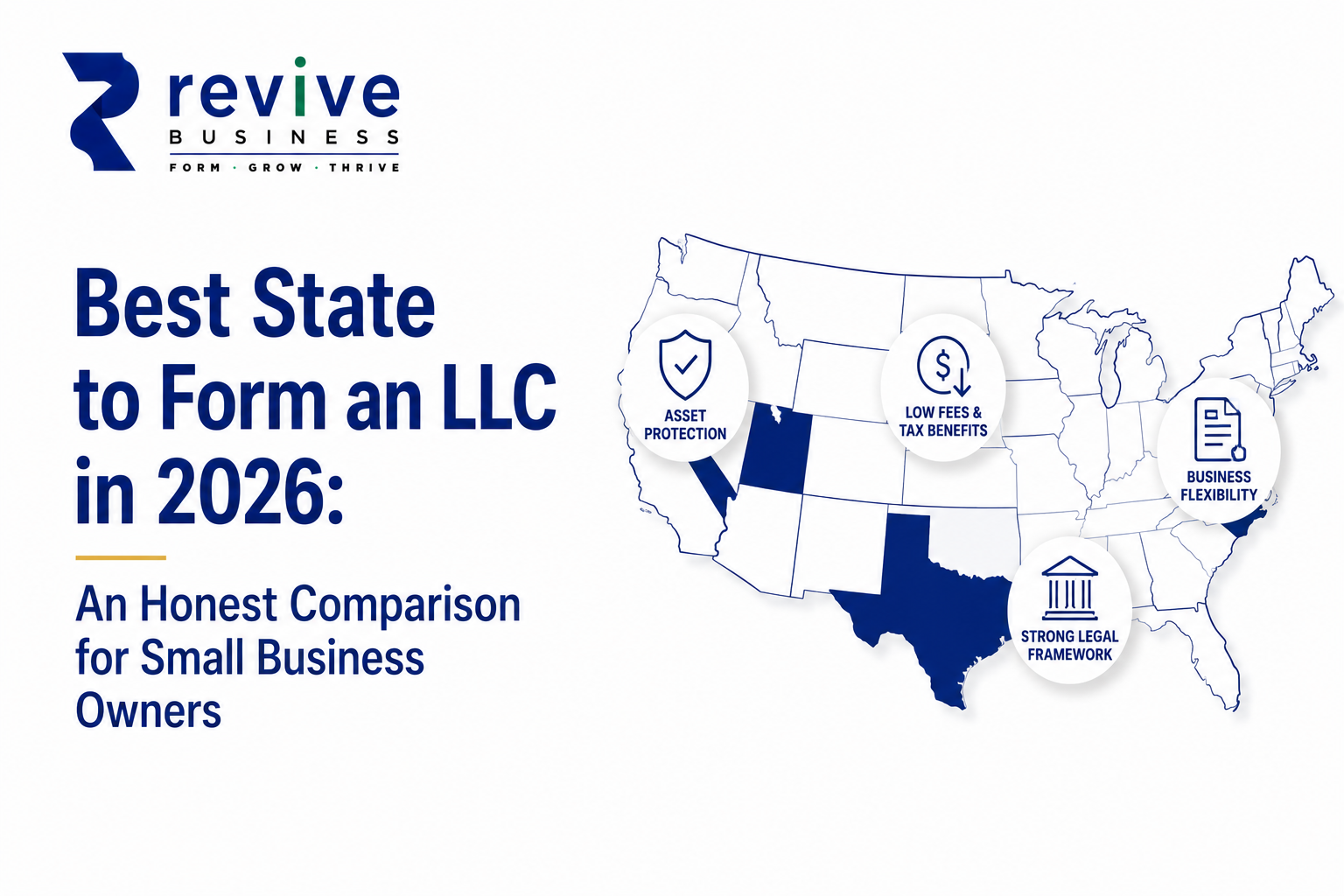
If you search for the best state to form an LLC, you will find no shortage of confident recommendations. Wyoming. Delaware. Nevada. The same names appear over and over, often written by people with a financial interest in steering you toward one answer.
The honest answer is more useful: the best state to form an LLC depends almost entirely on where your business actually operates and what you are trying to protect. This guide breaks down the real differences between the most commonly recommended states so you can make an informed decision rather than a popular one.
Why the State You Choose Actually Matters
Your state of formation determines your filing fees, annual compliance costs, privacy protections, tax obligations, and the legal framework governing your LLC. Choose a state that does not match your actual business location and you will almost certainly end up paying to register in two states simultaneously, once as a domestic LLC and again as a foreign LLC in the state where you actually do business.
That double registration means double registered agent fees, double annual report costs, and double the compliance calendar to manage. For most small business owners, it wipes out any financial advantage the so-called tax haven state offered in the first place.
The States Most Commonly Recommended and What They Actually Offer
Wyoming
Wyoming consistently earns its reputation as one of the most genuinely business-friendly states in the country. The LLC filing fee is $100, the annual report fee is just $60 for most businesses, there is no state income tax, no franchise tax, and member names are not required in public formation documents, which gives LLC owners a meaningful layer of privacy.
Wyoming also has some of the strongest charging order protections in the country, which limits a creditor's ability to go after your LLC membership interest if you face a personal judgment. For real estate investors, holding company structures, and entrepreneurs who prioritize asset protection, Wyoming is a legitimate top choice.
The caveat applies here as it does everywhere: if you live and operate in another state, you will need to foreign qualify there as well, which adds cost and compliance obligations.
Delaware
Delaware is the preferred formation state for venture-backed startups, companies planning to raise institutional investment, and businesses that may eventually go public. The Delaware Court of Chancery is the most sophisticated business court in the country, and investors and attorneys are deeply familiar with Delaware corporate law. If you are raising a seed round or planning a Series A, your investors may actually require Delaware incorporation.
For a small business owner, consultant, or e-commerce seller with no plans to raise outside capital, Delaware's advantages are largely irrelevant. The filing fee is $90 but the annual franchise tax for corporations can be substantial, and the $300 LLC annual tax is an ongoing cost with no corresponding operational benefit for most small businesses.
Nevada
Nevada is often promoted heavily online, and much of that promotion is tied to affiliate revenue rather than objective analysis. Nevada does have no state income tax and strong privacy provisions, but its annual fees are higher than Wyoming and the state has not built the same established legal reputation for LLC disputes. For most small business owners, Wyoming offers comparable or superior protections at lower cost.
Your Home State
For the majority of small business owners, forming an LLC in the state where you actually live and operate is the most practical and cost-effective decision. You avoid double registration, you avoid double registered agent fees, and you are already subject to that state's tax laws regardless of where your LLC is formed. The legal protections an LLC provides, primarily liability separation, apply equally in every state.
States like Ohio ($99 filing, no annual report), Montana ($35 filing, no sales tax), and Iowa ($50 filing, no franchise tax) offer genuinely favorable formation environments without requiring out-of-state registration gymnastics.
Side-by-Side Comparison of the Most Popular States
Wyoming: $100 filing fee, $60 annual report, no income tax, no franchise tax, strong privacy, strong charging order protection. Best for holding companies, real estate investors, and privacy-focused entrepreneurs.
Delaware: $90 filing fee, $300 annual LLC tax, no income tax on out-of-state income, sophisticated business court. Best for venture-backed startups and businesses seeking institutional investment.
Nevada: $75 filing fee, higher ongoing annual fees, no income tax, strong privacy. Best for certain asset protection strategies, though often overhyped relative to Wyoming.
Your home state: Varies by state, but avoids double registration costs. Best for most small business owners, freelancers, and local service businesses.
What Actually Determines the Best State for Your LLC
Before choosing a formation state, answer these questions honestly. Where do you physically live and work? Where do your clients or customers primarily interact with your business? Do you plan to raise outside investment? How important is privacy around your ownership information? What is your realistic annual compliance budget?
If you live in Texas and run a local consulting firm, forming in Wyoming and then registering as a foreign LLC in Texas costs you more and adds complexity with zero practical benefit. The liability protection, pass-through taxation, and professional credibility an LLC provides work exactly the same in Texas as they do in Wyoming.
If you are building a real estate holding structure, running a portfolio of assets across multiple properties, or building a business you genuinely expect to scale and potentially sell, the conversation changes. In those cases, a Wyoming or Delaware structure with proper registered agent service in each state of operation is worth the additional cost and complexity.
Registered Agent Requirements Regardless of Which State You Choose
Every state requires LLCs to maintain a registered agent with a physical address in the state of formation. If you form in Wyoming but live in California, you need a registered agent in Wyoming. If you then foreign qualify in California, you need a registered agent service in California as well. This is a recurring annual cost that factors into your total formation budget and should be included in any state comparison you make.
Many business owners initially list their home address as their registered agent to save money. This puts your personal address on a publicly searchable state database and requires you to be physically present at that address during all business hours to receive legal documents. A missed legal notice can result in a default judgment against your business with no opportunity to respond. Professional registered agent coverage eliminates that risk entirely.
Sales Tax Obligations Follow Your Customers, Not Your Formation State
One of the most persistent misconceptions about forming in a no-sales-tax state like Wyoming, Montana, or Delaware is that it relieves you of sales tax obligations. It does not. Your sales tax registration requirements are determined by where your customers are located and whether you have economic nexus in a given state, not by where your LLC was formed. If you sell to customers in Texas, California, or New York, you may owe sales tax in those states regardless of your LLC formation state.
Since the 2018 South Dakota v. Wayfair Supreme Court decision, states can require out-of-state sellers to collect and remit sales tax once they cross certain revenue or transaction thresholds. This applies to your business regardless of which state your LLC is registered in.
Frequently Asked Questions
Is Wyoming really the best state to form an LLC?
Wyoming is genuinely excellent for privacy, asset protection, and low ongoing costs. It is the best choice for holding companies, real estate investors, and anonymous LLC structures. For a small business owner who lives and works in another state, forming in Wyoming adds complexity and cost that often outweighs the benefits.
Should I form my LLC in Delaware if I am not raising venture capital?
Probably not. Delaware's advantages are primarily relevant to corporations seeking investment. For a standard small business LLC, the $300 annual tax and the need to foreign qualify in your home state make Delaware an unnecessarily expensive choice.
What happens if I form in Wyoming but live in Texas?
If you conduct business in Texas, you will need to register your Wyoming LLC as a foreign LLC in Texas. That means paying Texas filing fees, maintaining a registered agent in Texas, and meeting Texas annual compliance requirements in addition to Wyoming's. Your total cost will likely exceed what you would have paid to simply form in Texas from the start.
Does forming in a no-income-tax state reduce my personal tax bill?
No. LLC income passes through to your personal tax return, and you pay income tax based on where you live, not where your LLC is formed. If you live in California, you pay California income tax on your LLC profits regardless of whether your LLC is formed in Wyoming, Delaware, or California.
Ready to Form Your LLC in the Right State?
Choosing the right state is the first decision. Getting the formation right is the second. At Revive Business, our LLC formation services cover the full process from filing your formation documents to setting up your registered agent service in your chosen state. We also help business owners understand their sales tax registration obligations from day one so there are no compliance surprises after your first sale.
Get in touch with the team at Revive Business today and let us help you build on the right foundation from the start.