Bookkeeping vs. Accounting: What's the Difference and Why It Matters for Your Business
Bookkeeping vs. accounting: Discover the key differences in financial tracking, tax preparation, reporting, and how both drive small business growth.
Most small business owners use "bookkeeping" and "accounting" interchangeably. It's a natural slip-up: both relate to money, both involve numbers, and both are equally confusing when tax season arrives.
However, they are not the same. Knowing the disparity could save you from making costly choices that are based on incomplete financial information.
Let's clear up what each of them is, when you should use them, and how they all relate to maintaining a healthy business.
The Short Answer
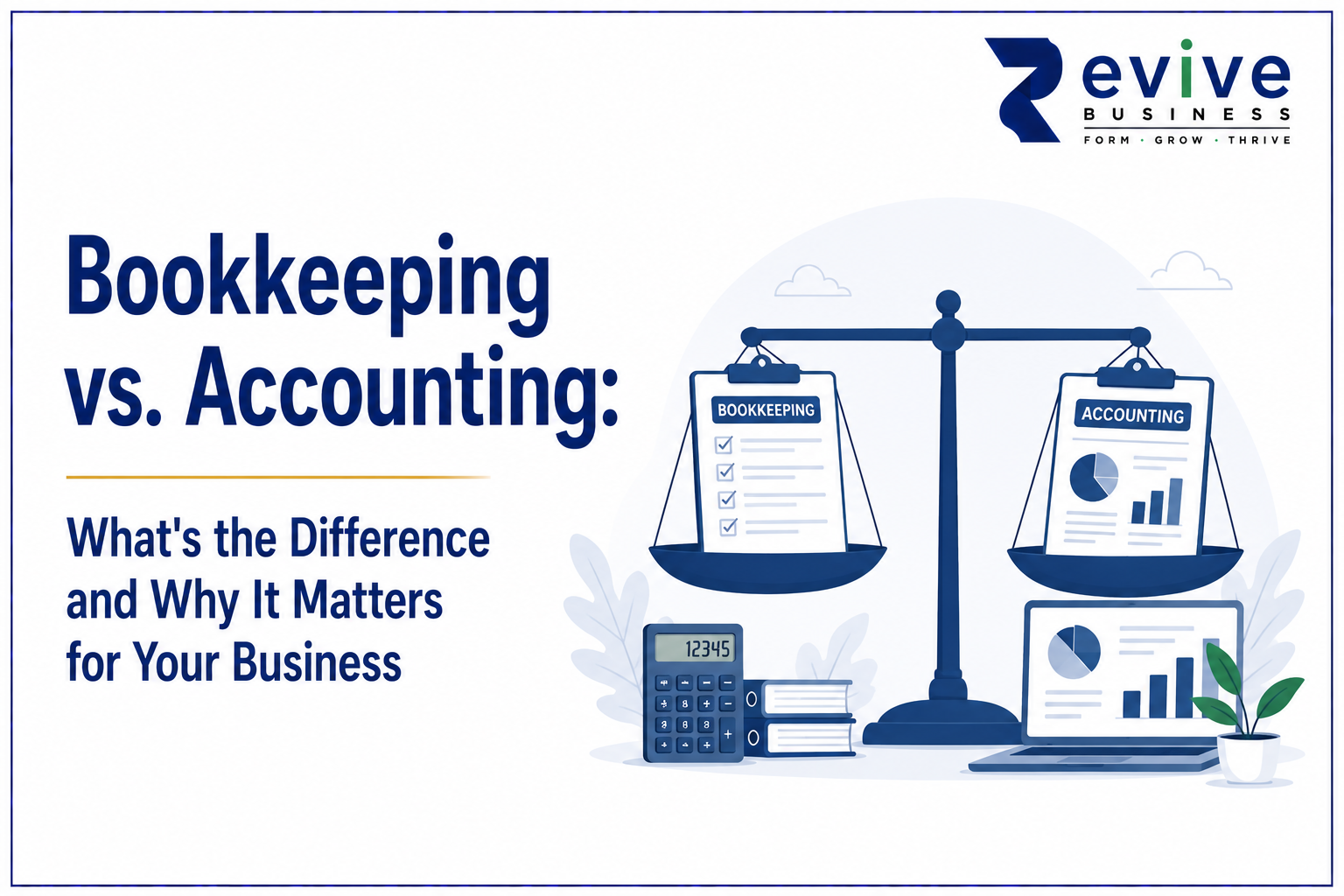
Bookkeeping is the task of recording financial transactions. Accounting involves the interpretation, analysis, and reporting of that data.
If you consider it in this sense, accounting is the output from bookkeeping. A bookkeeper maintains accurate and up-to-date books; an accountant reviews those books and provides insight into your business and what to do about it.
What Bookkeepers Actually Do
The role of a bookkeeper is to keep the financial records of a business in order and up-to-date. On a day-to-day basis, that typically includes:
-
Recording sales, purchases, receipts, and payments
-
Reconciling bank and credit card statements
-
Managing accounts payable and receivable
-
Processing payroll entries
-
Maintaining the general ledger
Accuracy is everything in bookkeeping. If transactions are miscategorized or entries are missed, everything built on top of that data- your financial statements, your tax filings, your business decisions- becomes unreliable.
A real-life example: let's say you are a retail store owner who does not reconcile your accounts every month. After six months, you find $4,000 in duplicate vendor payments, which no one noticed. It's a bookkeeping issue, and it is a very common one.
Bookkeeping is typically handled by a bookkeeper or an in-house admin using software like QuickBooks, Xero, or Wave.
What Accountants Actually Do
Accounting builds upon bookkeeping. An accountant understands the organized financial information and translates it into workable data.
Common Accounting duties include:
-
Preparing and analyzing financial statements (Profit & Loss, Balance Sheet, Cash Flow)
-
Filling out business and personal income tax returns.
-
Identifying tax-saving opportunities
-
Providing business structure and financial advice
-
Conducting or assisting others with audits
-
Forecasting and budgeting
A good accountant does not only tell you what is happening, she tells you what is happening, and what you should do about it. One such example is if a business owner is experiencing a 20% increase in revenue on an annual basis, it might be assumed that all is well. But an accountant looking at the same data may see that margins are narrowing and cash flow is becoming tight, and make recommendations before it becomes a problem.
In most countries, accountants are professionally qualified. CPAs are licensed by the state boards of accountancy in the U.S. and must adhere to a code of conduct and ethics. You can verify a CPA's license through the AICPA or your state's licensing board.
Key Differences at a Glance
|
Bookkeeping |
Accounting |
|
|
Focus |
Recording transactions |
Interpreting financial data |
|
Output |
Well-coordinated records and books |
Reports and forecasts, tax filings |
|
Frequency |
Ongoing, day-to-day |
Occurring regularly (monthly, quarterly, or annually) |
|
Decision-making |
Descriptive |
Strategic |
|
Credentials required |
Generally no |
A lot of the time (CPA, CMA, etc.) |
When Do You Need One vs. the Other?
Now it gets real.
Bookkeepers are needed when:
-
You're spending hours a week manually keeping up with transactions.
-
Records are inconsistent or out of date.
-
You're growing, and volume is becoming unmanageable
-
You need clean data before tax season (not in April!)
An accountant will be required when:
-
It's time to file business taxes
-
You're making major financial decisions (taking on investment, buying equipment, expanding)
-
You need a financial review or audit
-
You want to understand whether your business is actually profitable, and why
Both are great for many small businesses. A bookkeeper is responsible for the day-to-day bookkeeping, while an accountant will review the books from time to time and take care of tax strategy. This configuration is cost-effective without letting anything fall through the cracks.
Why Getting This Right Matters from Day One
The earlier you get your financial systems in order, the easier everything downstream becomes.
Clean bookkeeping makes it easier for businesses to file tax returns, obtain loans, attract investors, and comprehend their profits. Those who do often take a lot of time and money to clean up their mess before they can do anything else.
This is particularly the case when you're establishing a new business. Whether you're registering your company as an LLC, corporation, or partnership, you should not overlook your accounting and bookkeeping system. When you combine a solid financial approach with company formation services, you begin with a clean slate and don't need to come up with a workaround plan to maneuver through the financial minefield.
Professional accounting and bookkeeping services can set up your chart of accounts, establish reporting workflows, and ensure your records are structured correctly from the beginning, saving you significant headaches as your business grows.
A Note on Software vs. Professional Help
Nowadays, it is easier than ever before to manage your own books with accounting software. Easier does not equal better.
Software keeps track of what you say to it. It won't alert you to a miscategorized expense, a missed deduction, or a model that's silently ebbing your margins. This is where experienced professionals become invaluable, which cannot be replicated by any dashboard.
See software as a tool rather than a goal. Trust professionals' judgement.
Frequently Asked Questions
Can a bookkeeper do accounting work?
There is some overlap, as more skilled bookkeepers may be able to draft simple financial statements. However, bookkeepers don't have the same credentials as licensed accountants, and therefore, won't be able to do a lot of the things that licensed accountants can do, such as filing taxes and auditing accounts.
Does bookkeeping still have to be done when using accounting software?
Yes. Software is used to automate some tasks, but it is not enough to replace the need for accurate and consistent data entry and reconciliation. Garbage in, garbage out!
When is it that a small business needs a bookkeeper?
If the administrative overhead of keeping track of finances begins to eat up time you should be spending on the business, earlier than you think.
What is the difference between a CPA and the regular accountant?
A CPA (Certified Public Accountant) is a graduate of the Uniform CPA Exam who is licensed by the state. Not all accountants are CPAs, but CPAs are subject to a higher law and ethical standard.
Is it necessary to use both a bookkeeper and accountant?
Yes, for the majority of growing businesses. They have different functions, and using both can be a more cost-efficient method than having an accountant take care of day-to-day bookkeeping.
Final Thoughts
Bookkeeping keeps your financial records accurate and current. With accounting, you can make sense of them. Both, and those businesses that think of financial management as a daily activity, will stay ahead.
Whether you're small or growing, at Revive Business, we offer accounting and bookkeeping services that are customized to your business needs, from keeping your books clean and consistent to giving you insightful financial advice. We can help you get started or organize years of disorganized records.
Get in touch today and let's build a financial foundation your business can actually grow on.