Can a Non-US Citizen Own an LLC? Everything Foreign Entrepreneurs Need to Know
Yes, a non-US citizen can own an LLC. Learn which states allow it, what documents you need, how taxes work, and what mistakes foreign owners commonly make.
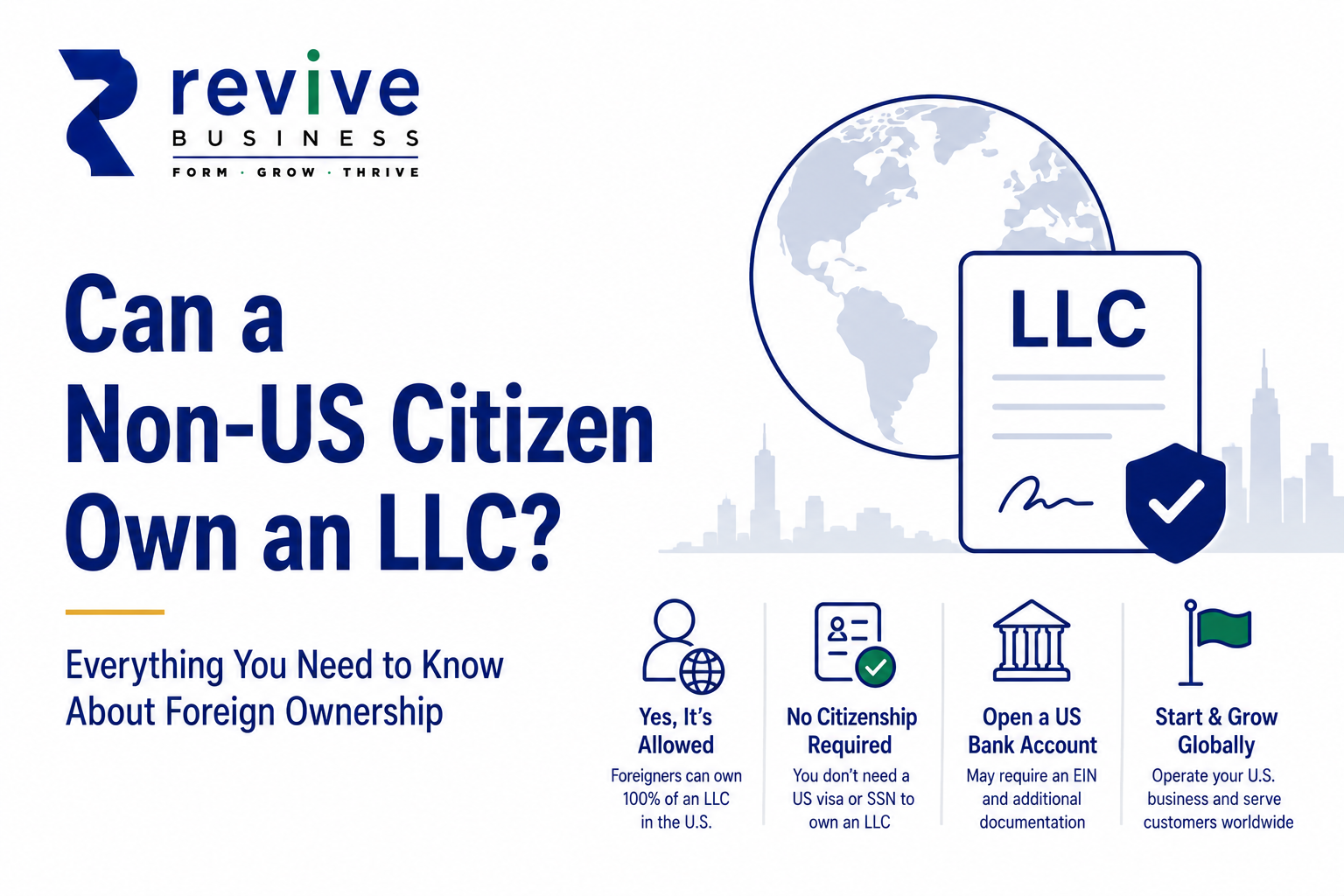
Yes. A non-US citizen can own an LLC in the United States. There is no federal law or state law that prohibits foreign nationals, non-residents, or non-citizens from forming and owning an American LLC. This is one of the most misunderstood facts about US business formation, and it opens a significant opportunity for entrepreneurs around the world who want access to the US market, US banking infrastructure, and the legal protection that an American business entity provides.
That said, owning an LLC as a foreign national is not identical to owning one as a US citizen. There are specific requirements around tax identification, federal tax filings, banking, and ongoing compliance that foreign owners must understand before forming their entity. Getting these wrong creates problems that are expensive to unwind, particularly around IRS reporting obligations that many foreign LLC owners discover late.
This guide covers everything a non-US citizen needs to know about owning a US LLC, from formation through ongoing tax and compliance obligations.
Which States Allow Non-US Citizens to Form an LLC
All 50 US states permit non-US citizens and non-residents to form and own an LLC. You do not need to be a US citizen, a green card holder, or even a US resident to register an LLC in any American state. The only universal requirement is that you designate a registered agent with a physical address in the state where your LLC is formed.
The states most commonly chosen by foreign entrepreneurs are Wyoming, Delaware, and Florida. Wyoming is popular because it has no state income tax, strong privacy protections, low annual fees, and one of the most business-friendly LLC statutes in the country. Delaware is preferred by entrepreneurs planning to raise investment capital because of its well-developed corporate law framework and investor familiarity. Florida attracts foreign owners because of its large international business community, no state income tax, and proximity to Latin American markets.
New Mexico is also worth mentioning for foreign owners specifically because it does not require an annual report, which reduces the ongoing compliance burden for entrepreneurs who are managing their US entity from abroad. The filing fee is low and the formation process is straightforward.
What You Need to Form a US LLC as a Foreign National
The documentation required to form a US LLC as a non-citizen is simpler than most foreign entrepreneurs expect. You do not need a US address of your own, a US bank account, a Social Security Number, or a visa to form the entity itself. The core requirements are your personal identification, a registered agent in your chosen state, and the relevant state filing fee.
A Registered Agent with a US Address
Every LLC in every US state must have a registered agent with a physical street address in the state of formation. As a foreign owner who does not live in the United States, you cannot serve as your own registered agent. This makes a professional registered agent service not optional but a genuine necessity for foreign-owned LLCs. The registered agent receives your legal documents, government correspondence, and official state notices on behalf of your business and forwards them to you wherever you are in the world.
A Federal Employer Identification Number
After your LLC is formed, you need to obtain an Employer Identification Number from the IRS. An EIN is a federal tax ID that your LLC needs to open a US business bank account, file US tax returns, hire employees if applicable, and conduct most formal business activities in the United States. As a foreign national without a Social Security Number, you apply for your EIN using IRS Form SS-4 and must submit the application by mail or fax rather than through the online portal, which is restricted to applicants with a US Social Security Number or Individual Taxpayer Identification Number. Processing time for international fax submissions is typically four to six weeks.
An Operating Agreement
While most states do not legally require an operating agreement, it is particularly important for foreign-owned LLCs. US banks often request it when opening a business account for an entity with non-US citizen owners. It also documents your ownership of the entity clearly, which matters when dealing with US counterparties, investors, or government agencies that may have questions about a foreign-owned business.
How a US LLC Is Taxed When Owned by a Non-US Citizen
This is where foreign LLC ownership gets significantly more complex than domestic ownership, and where most foreign entrepreneurs encounter problems. US tax obligations for foreign-owned LLCs depend on several factors including whether the LLC has US-sourced income, whether it is treated as a disregarded entity or a corporation for tax purposes, and whether the owner is classified as a non-resident alien or a US person for tax purposes.
Single Member LLC Owned by a Foreign National
A single-member LLC owned by a non-US citizen is treated as a disregarded entity by the IRS by default, the same as a single-member LLC owned by a US citizen. The tax treatment of the income depends on whether it is effectively connected income, meaning income generated from business activities conducted within the United States, or non-effectively connected income from sources outside the United States.
If your LLC earns income from US sources or conducts business activities within the United States, that income is subject to US federal income tax. You will need to file a US tax return as a non-resident alien and report that income. If your LLC is purely a conduit for business conducted entirely outside the United States with no US-sourced income, the federal income tax picture is different, though reporting obligations may still apply.
Form 5472 Is Not Optional
This is the most commonly overlooked compliance requirement for foreign-owned single-member LLCs. Since 2017, the IRS requires foreign-owned single-member LLCs to file Form 5472, the Information Return of a 25% Foreign-Owned US Corporation or a Foreign Corporation Engaged in a US Trade or Business, along with a pro forma Form 1120 corporate return. This filing is required even if the LLC has no income, no employees, and no US business activity. It is a pure reporting requirement.
The penalty for failing to file Form 5472 is $25,000 per violation, per year. This is one of the highest automatic penalties in the US tax code, and the IRS applies it without discretion. Many foreign LLC owners discover this requirement only after receiving an IRS notice with a substantial penalty already assessed. The filing deadline is the same as the corporate return deadline, April 15 for calendar-year entities with an extension available to October 15.
Withholding Tax on US-Sourced Income
If your LLC earns certain types of US-sourced income such as rent, royalties, interest, or dividends, US withholding tax of 30% may apply unless a tax treaty between the United States and your country of residence reduces that rate. The United States has income tax treaties with more than 60 countries, and treaty benefits can significantly reduce withholding obligations. Whether a treaty applies to your situation depends on the specific type of income and the treaty terms with your country.
Opening a US Business Bank Account as a Foreign LLC Owner
Opening a US bank account is one of the most practical challenges foreign LLC owners face. US banks are subject to strict anti-money laundering and know-your-customer regulations, and many traditional banks require in-person account opening with a US address, making it difficult for non-resident foreign owners to open accounts without travelling to the United States.
The most commonly used solutions among foreign LLC owners are digital-first business banking platforms that are more accommodating of non-resident applicants, visiting a US bank branch in person during a trip to the United States, using a bank in your home country that has a US banking relationship, or working with a bank in a jurisdiction that serves international business clients with US entities.
Having your EIN in hand, your stamped formation documents, your operating agreement, and a passport is the minimum documentation you should have ready before attempting to open any US business account. Some banks will also ask for proof of the business purpose and information about expected transaction volumes.
Does Owning a US LLC Affect Your Immigration Status
Owning a US LLC does not by itself grant you the right to live or work in the United States. It does not affect your visa status, your immigration proceedings, or your ability to enter the country. The right to own a business entity and the right to live and work in the country are entirely separate legal questions governed by entirely separate bodies of law.
If you plan to travel to the United States to conduct business activities on behalf of your LLC, the type of visa you need depends on the nature of those activities and your country of origin. Some business activities are permitted on a B-1 business visitor visa while others require a work visa. If you intend to relocate to the United States and actively manage your LLC from within the country, you will need appropriate work authorization independent of your LLC ownership.
Common Mistakes Foreign LLC Owners Make
Ignoring the Form 5472 filing requirement is the most costly mistake and the most common. The $25,000 annual penalty is not proportional and it is not subject to negotiation in the way many other IRS penalties are. Every foreign-owned single-member LLC must file this form regardless of income or activity level.
Assuming that forming in a no-income-tax state eliminates all US tax obligations is a dangerous misconception. Your state of formation affects state-level taxes, but federal tax obligations are determined by where your income is sourced and how it is classified, not by which state issued your LLC certificate.
Using a personal address or a friend's US address as the registered agent is a compliance risk. A registered agent must be reliably available during business hours to receive legal documents. Missing a legal notice because your informal arrangement failed can result in a default judgment against your LLC with no opportunity to respond.
Failing to maintain the LLC properly after formation is also common among foreign owners who are managing from a distance. Annual reports, registered agent renewal fees, and state tax filings have deadlines that do not pause because you are in a different time zone. Administrative dissolution of a foreign-owned LLC can create complications around the EIN, banking relationships, and any contracts the LLC has entered into.
Frequently Asked Questions
Do I need a US visa to own an LLC?
No. You do not need a visa of any kind to own a US LLC. LLC ownership is a property right separate from immigration status. You can form and own a US LLC while living entirely outside the United States without ever entering the country.
Can a foreign company own a US LLC?
Yes, with some nuances. A foreign corporation or other foreign entity can own a US LLC. However, if a foreign corporation owns a US LLC, the tax treatment and reporting requirements become more complex and may involve additional IRS filings. The S corporation tax election is not available to LLCs with corporate owners, which limits certain tax planning strategies.
Which state is best for a foreign-owned LLC?
Wyoming and New Mexico are most commonly recommended for foreign owners who want simplicity and low ongoing costs. Wyoming offers strong privacy, no income tax, and low fees. New Mexico requires no annual report, which reduces the compliance calendar. Delaware is preferred when the LLC will be seeking US investment. The right choice depends on your business purpose, where your customers are, and how much ongoing compliance you can manage from abroad.
Does a foreign-owned LLC need to file a US tax return if it has no US income?
Potentially yes. Even with no US-sourced income, a foreign-owned single-member LLC is required to file Form 5472 and a pro forma Form 1120 annually as long as the LLC is active. This reporting requirement exists regardless of income level or business activity within the United States. Failure to file carries an automatic $25,000 penalty per year.
Can a foreign LLC owner get an ITIN instead of a Social Security Number?
Yes. An Individual Taxpayer Identification Number is issued by the IRS to individuals who are required to have a US taxpayer identification number but are not eligible for a Social Security Number. Foreign LLC owners who have US tax filing obligations can apply for an ITIN using IRS Form W-7. Having an ITIN enables you to file US tax returns and in some cases can streamline the EIN application process.
Ready to Form Your US LLC as a Foreign Entrepreneur?
Forming a US LLC as a non-citizen is entirely achievable and for many foreign entrepreneurs it is one of the most valuable business decisions they make. The access to US markets, US banking, and the credibility of an American business entity are genuinely significant advantages. The key is getting the formation right from the start, having a reliable registered agent in place, understanding your federal reporting obligations before the first filing deadline arrives, and maintaining the entity properly from a distance.
At Revive Business, our LLC formation services are designed to handle every step of the process for foreign entrepreneurs, from selecting the right state and filing your formation documents to setting up registered agent coverage and guiding you through the EIN application process. We work with business owners in over 20 countries who have formed US entities through our team and continue to manage their compliance from abroad.
Reach out to the team at Revive Business today and let us get your US LLC set up correctly from the first filing.