DBA vs LLC: What's the Difference & Which to Choose?
Compare DBA vs LLC to understand legal protection, tax implications, setup costs, and registration rules so you can pick the right structure.
When you're beginning a business, you've most likely seen these two terms: DBA and LLC. They're similar, but they're very different, and choosing the wrong one could expose you to unnecessary risk, higher costs, and complications as your business grows.
This guide explains the differences in simple terms to help you make the right decision for you.
What Is a DBA?
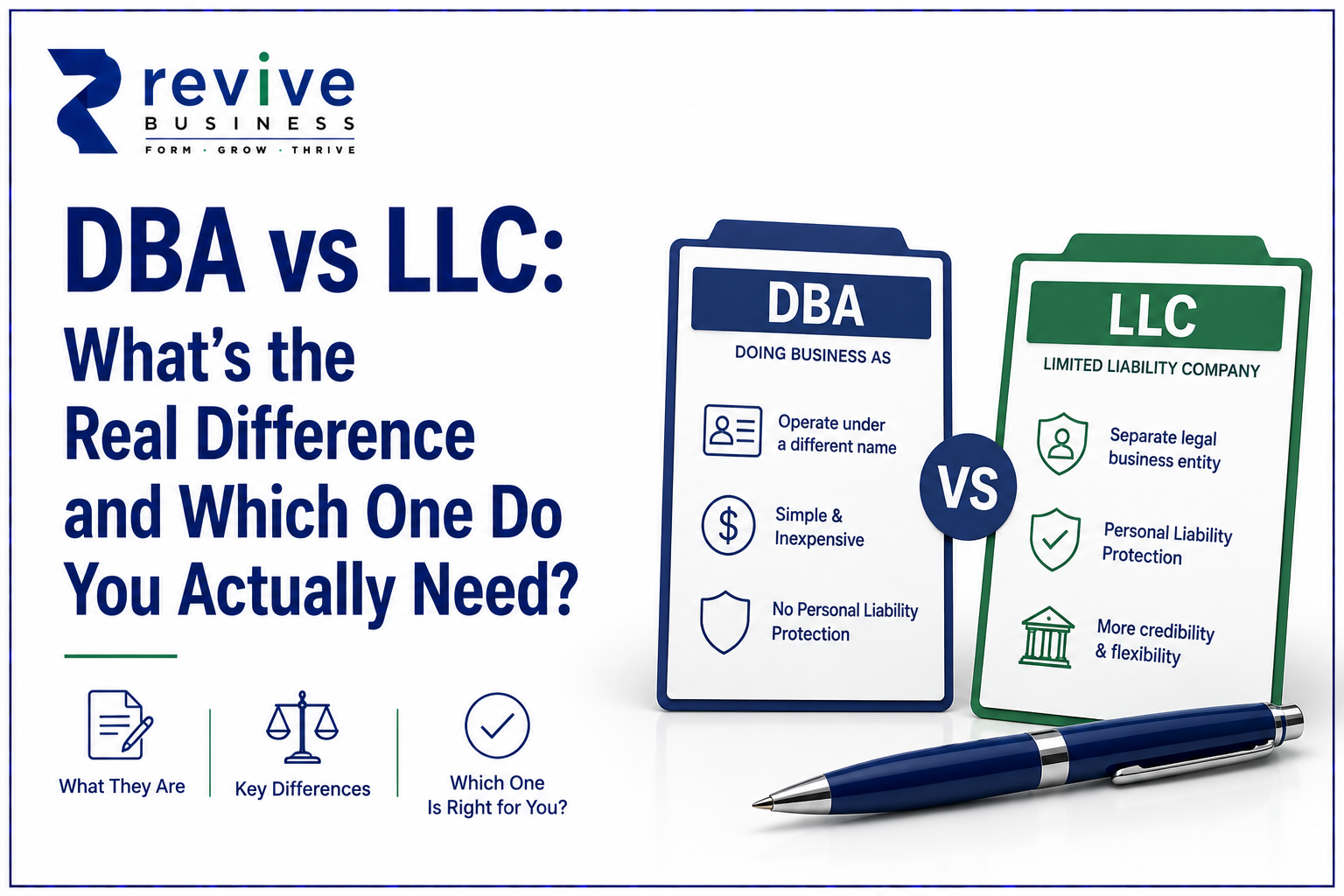
The acronym DBA means “Doing Business As.” It is also known as a fictitious name or trade name in your state.
The DBA is not the business structure; it's a name registration. It allows a sole proprietor, partnership, or existing LLC to run a business under a different name without creating a new legal entity.
Suppose your name is Michael Torres and you're a freelance designer. Instead of operating under your personal name, you'd rather do business as 'Pixel Studio.' By filing a DBA, you can use that name on invoices, marketing materials, and potentially open a business bank account, depending on your bank's requirements. However, you are not creating a separate legal entity.
That's what all a DBA does. It's a name, NOT a shield.
What Is an LLC?
An LLC (Limited Liability Company) is an authentic legal business entity that is registered with the state. It legally and financially distinguishes you as a person from your business.
An LLC is a legal entity, which means that when it is created, the business itself will be recognized as the LLC. That means:
-
If your business is sued, an LLC generally helps protect your personal assets, such as your home, car, and savings, provided you maintain the LLC properly and keep business and personal finances separate
-
The business can sign contracts, open an account, and own property in its own name.
-
You increase your chances of credibility with clients, vendors, and lenders.
Example: A client sues you for $80,000 in damages, and you are a contractor. With a sole proprietorship only having a DBA, your personal assets are at risk. In many cases, claims are limited to the LLC's assets rather than your personal assets.
The IRS's business structures page explains these structures in more detail.
DBA vs LLC: Quick Comparison
|
Feature |
DBA |
LLC |
|
Legal Protection |
None |
Personal liability protection |
|
Separate legal entity |
No |
Yes |
|
Tax flexibility |
Limited |
Multiple options |
|
Setup cost |
$10–$100 |
$50–$500+ |
|
Lender credibility |
Lower |
Higher |
Key Differences That Actually Matter
Here are some of the key differences you should be aware of.
1. Legal Protection
No liability coverage is provided by a DBA. If you're operating as a sole proprietor under a DBA, business debts and legal claims may extend to your personal assets because there is no legal separation between you and the business. An LLC establishes a separation between your personal and business financial problems.
An LLC, however, is not foolproof. If you commingle business and personal money, courts can "pierce the corporate veil". To preserve liability protection, maintain separate business records and bank accounts, avoid mixing personal and business funds, and comply with your state's filing requirements.
2. Tax Treatment
A DBA does not change how your business is taxed. If you're a sole proprietor using a DBA, you'll generally report business income on your personal tax return and pay applicable self-employment taxes.
An LLC offers additional tax flexibility. By default, a single-member LLC is taxed as a sole proprietorship, but eligible LLCs may elect S corporation taxation, which could reduce self-employment taxes once the business reaches sufficient profitability.
3. Credibility and Financing
While businesses operating under a DBA can still obtain financing, lenders often view LLCs as more established because they provide formal registration and legal separation. An LLC puts you in a much stronger position if you are looking to apply for business loans, use commercial real estate leases, or bring in investors.
4. Name Protection
A DBA generally does not provide broad rights to a business name beyond the jurisdiction where it's registered. In contrast, LLC names are typically protected at the state level, preventing another LLC in the same state from registering an identical name. Neither option automatically grants federal trademark protection.
When a DBA Makes Sense
-
Entrepreneurs seeking a business name without LLC paperwork
-
Existing LLCs that want to operate multiple brands without forming separate entities.
-
Low-risk businesses that have low liability.
-
Taking a concept to market first before going all in.
When an LLC Is the Better Move
-
You're hiring employees, signing contracts, or taking on larger clients.
-
Your business operates in an industry with higher liability exposure, such as consulting, construction, or health and wellness services.
-
You want to establish and maintain a clear separation between your personal and business finances and credit.
-
You are looking to scale or to add partners to your business.
Professional LLC formation services help you set things up right and avoid costly filing mistakes.
Can You Have Both?
Yes, and it's a good idea. An LLC can be established, and DBAs can be registered in an LLC to conduct multiple brands without the establishment of multiple legal entities.
For example, a company named Revive Holdings LLC may operate under trade names such as "Revive Marketing" and "Revive Design" by registering them as DBAs, while the legal entity remains Revive Holdings LLC. One company, many brands, full protection.
Don't Overlook Your Registered Agent
Most states need LLCs to have a registered agent that is a person or company with a physical address in the state where the LLC is incorporated, and that has the authority to receive legal notices on your behalf.
The majority of business owners opt for a professional registered agent service, as it provides them with privacy and reliability. Your personal address does not appear on public records, and a professional is always available during business hours to receive documents. Failure to receive a legal notice can have serious repercussions.
Business formation rules vary by state. Consider speaking with a qualified attorney, accountant, or business advisor regarding your specific circumstances.
Frequently Asked Questions
Do I need an LLC if I already have a DBA?
Not necessarily, but you should consider it. A DBA does not protect your personal assets. In the event of a lawsuit or debt, you and your business are at risk. An LLC does not.
Can I convert my DBA to an LLC later?
Yes. Many owners begin their business with a DBA and then establish an LLC as their company expands. Remember, your DBA registration does not automatically renew; you need to re-register it under the new LLC.
Is an LLC better for taxes?
It can be. By default, both are treated the same for tax purposes, and once profitable, an LLC may choose to be treated as an S-Corp, which may result in a reduction of self-employment taxes. Consult with an accountant and find out if it applies to you.
Do I need a registered agent for a DBA?
No. Registered agents are required for LLCs and corporations, not for sole proprietors operating under a DBA.
Final Thoughts
A DBA is simply a name. An LLC is a company.
For a low-risk idea, you can use a DBA for the present. If you're creating a real thing, however, an LLC is likely the wiser footing. The difference in price between the two is negligible. The difference in protection is gigantic.
We can help you with the structuring of your business at Revive Business from startup through LLC formation right up to accounting services and registered agent services.
Ready to build on the right foundation? Connect with our team.