Does Utah have state income tax?
Does Utah have state income tax? Yes. Learn about Utah's flat 4.45% individual income tax rate, filing requirements, and taxpayer credits for 2026.
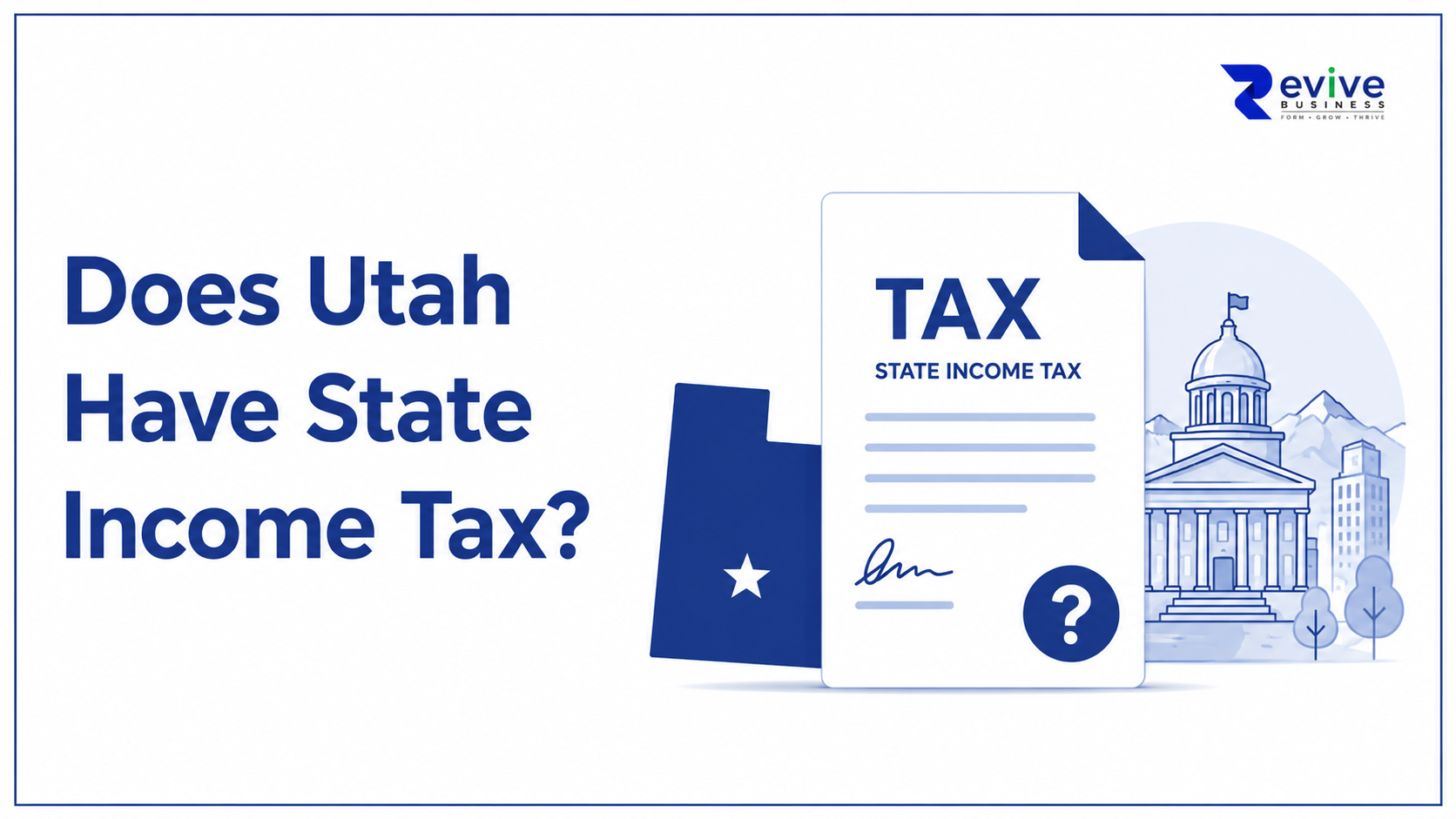
Yes, there is a Utah state income tax. But it's unique from many states in that it has a flat rate of 4.45%, regardless of income. No thresholds, no brackets, only the same rate.
Whether you just moved to Salt Lake City, launched a startup in Provo, or are planning a Utah company formation, understanding how the state income tax works and how it affects your bottom line is something you should get right from the start. This guide walks you through exactly that.
How the Flat Rate Works in Practice
The percentage with which each state taxes income varies by income level - in progressive states, the higher the income, the higher the percentage - Utah applies a flat 4.45% income tax rate. With that in mind, budgeting and tax planning are easy.
Let's take a look at the real-life math:
-
The approximate State income tax before credits for a salaried employee making $60,000.00 a year is $2,730.00.
-
A small-business owner who makes $150,000 in pass-through income would be liable for approximately $6,825, before any deductions.
-
If a dual-income family has a total of $200,000, they'll be paying roughly $9,100 in state taxes.
While the exact amount you will pay will be based on your filing status and any credits you are eligible for, the flat rate makes it a dead sure thing to estimate, which is something most states that have tiered rates cannot offer.
Who's required to file a Utah State return?
The majority of Utahns earning any significant amount of money must file. Here are a couple of scenarios you should be aware of:
-
Full-year residents are required to file all income for the year, whatever its source.
-
Part-year residents, if a person lives in Utah for part of the year, they report their earnings from Utah. If you move during the year, you must file, but it will be in a different form.
-
Nonresidents may still be liable to pay income tax in Utah on work or business activity performed in the state.
-
LLCs, S-corp, partnerships, etc, have pass-through income where the business owner reports the income on their personal Utah return.
When in doubt, be always better to involve appropriate Utah state tax filing services early on, particularly following a move or after launching a business, to avoid the hassles later.
Credits That Can Reduce What You Owe
-
The flat rate does not imply that you can't reduce your bill. Utah has a couple of redeeming features:
-
Personal exemption credit: A non-refundable credit of $35 per exemption. Simple yet significant.
-
Taxpayer tax credit: For lower and middle-income tax filers. This credit may affect, or wipe out, your state tax liability, depending on your income.
-
Federal deduction passthrough: Utah uses your federal AGI. Funding to a SEP-IRA, HSA, or student loan interest that lowers your federal AGI will also lower your Utah taxable income.
Real example: A self-employed consultant in Ogden makes a contribution of $20,000 to a SEP-IRA. That decreases the federal AGI and saves approximately $910 in Utah state taxes.
Common Mistakes To Avoid
Here are some common mistakes to avoid when managing your Utah tax filings:
-
Failure to make estimated payments quarterly. Utahns who own their own business are required to pay quarterly. Failure to pay in full by April results in penalties for these triggers.
-
The improper filing as a part-year resident. This is included in specific sections on the Utah TC-40 form. It's not a good idea to file as a full-year resident when you aren't, or vice versa.
-
Ignoring out-of-state income. Utahns freelancing outside of the state are taxable in Utah. You may get a credit for taxes paid to other states, but you still have to report it.
-
Poor recordkeeping. Books that are not in order can result in omissions. Professional bookkeeping for small businesses is worthwhile for a better peace of mind.
Key Filing Deadlines
-
Individual returns due April 15th
-
Extension deadline: October 15 (extension to file and extension to pay)
-
The estimated payments are made quarterly, in April, June, September, and January.
If a late filing occurs after the deadline without an extension, there will be a 10% late filing fine on the amount of tax due, and interest will also begin to accrue daily. These costs can all be avoided; it's usually simply a reminder on the calendar and a general idea of what you owe.
Get the Right Help From The Start
We at Revive Business help Utah residents and business owners with tax filing, so it is easy and accurate. You can count on us to get you started on your Utah business formation, to keep you up to date with your Utah state tax filing, and to provide professional bookkeeping for small businesses, without having to guess.
For more information, please visit Revive Business and schedule a consultation.
We have worked with small business owners in Utah who find themselves coming to us after years of filing taxes themselves to discover that they missed out on credits, reported part-year income, and/or underpaid quarterly taxes, and didn't realize it. It will always cost more to fix than to prevent. It's nearly always better to get the right support early.
Frequently Asked Questions
Will Utah's 4.45% rate change anytime soon?
Possibly. It has been reduced in Utah a couple of times in recent years (it was 4.85% not long ago). Be sure to visit the Utah State Tax Commission's website every year for updates.
I work remotely for a company based in another state. Do I owe Utah income tax?
Yes. Your wages are considered income in Utah, no matter where your employer is located. If your employer has already withheld from you in another state, you might be eligible for a credit to prevent you from paying twice.
My LLC is registered in Nevada, but I live in Utah. Am I off the hook?
No. Utah's tax laws require that all income, such as distributions from an out-of-state LLC, be taxed on a resident's income. You are not exempt from a personal tax liability in Utah by registering in another state. It's one of the most frequently encountered misunderstandings we're faced with.
What's the difference between an extension to file and an extension to pay?
An extension only allows you to file your return sooner, but it does not give you more time to pay. If you are liable to pay tax, it will still be due on April 15. Late payments (including late payments pursuant to an extension) result in interest and penalties.