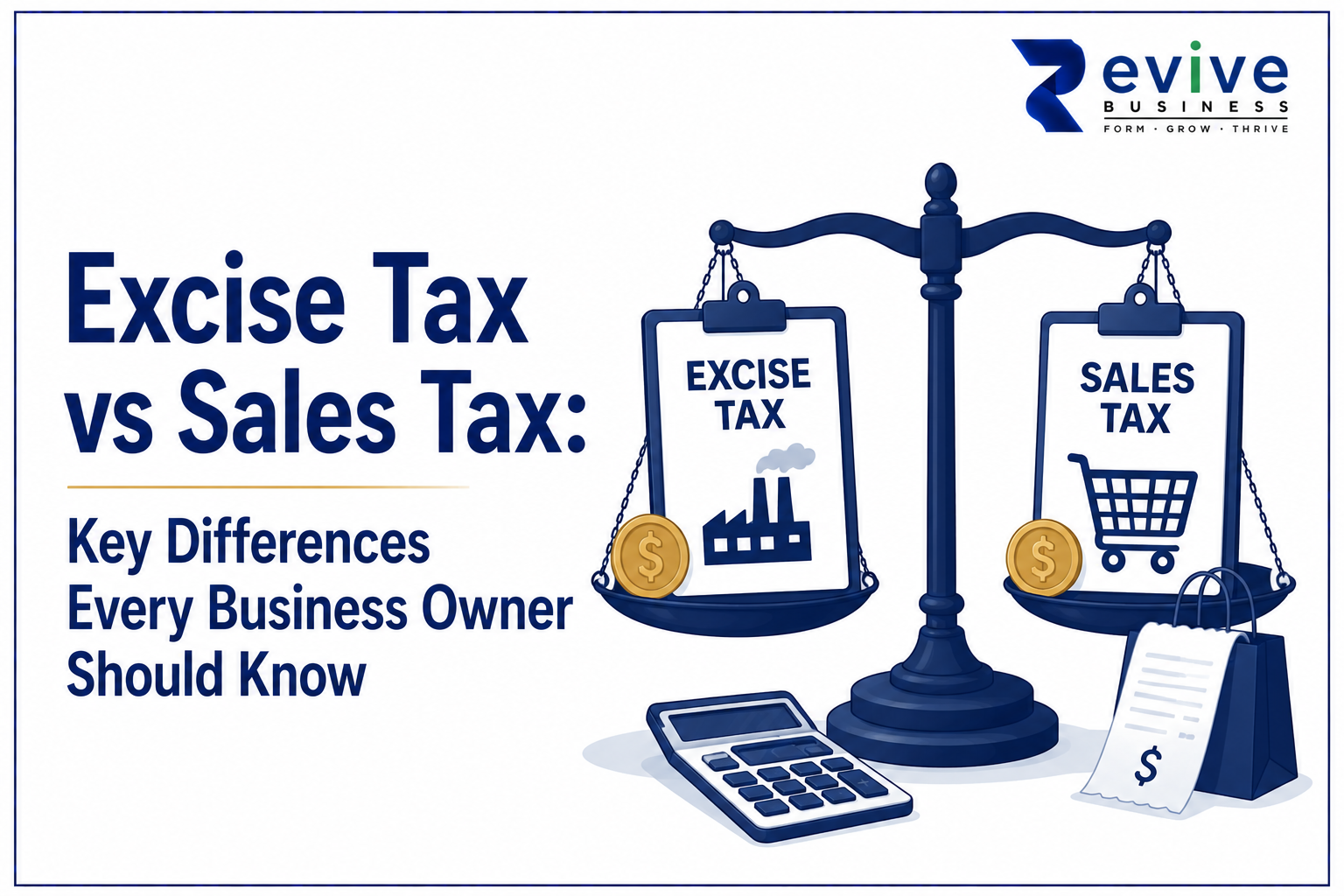
Excise Tax vs Sales Tax: Key Differences Every Business Owner Should Know
Confused by excise tax vs sales tax? Learn key differences in tax targets, pricing inclusion, and compliance rules to keep your business tax-ready.
Most business owners are aware that they must pay taxes. Not many people know and understand what taxes apply to them, and this is where compliance issues begin.
Some of the most confusing types of tax are sales tax and excise tax. They both serve as indirect taxes, impact the cost of goods, and carry real penalties when misused. However, they are very different, are applied to different circumstances, and have different implications for your business.
Understanding the distinction isn't just useful trivia. It impacts your tax registration, your tax filing, your accounting and bookkeeping methods, and your risk of being audited.
What Is Sales Tax?
Sales tax is a tax applied at a certain percentage on the retail sale of most goods and some services. It is collected at the time of purchase by the customer and then is remitted to the proper tax authority by the business.
How it works in practice:
A customer purchases a $100 product from a retail outlet in a state that has a 7% rate of sales tax. The business determines the price of $107 at the cashier; $100 goes to the business, and $7 goes to the state.
The business does not "pay" the sales tax itself; rather, it is the collection agent. However, the responsibility to accurately collect, track, and remit rests 100% with the business. Miss a deadline and/or incorrectly calculate the rate, and the liability falls to you. Proper sales tax compliance and registration helps businesses avoid costly penalties while ensuring they meet their obligations in every jurisdiction where they operate.
Each state has its own sales tax laws. Some states charge a tax on clothing and groceries, while others do not. Not all digital services are created equal. Currently, there are 45 states and D.C. that have a state sales tax.
What Is Excise Tax?
Excise Tax is a tax on the manufacture, sale, or consumption of particular goods or services. Excise tax is narrow-based, in contrast to a broad-based sales tax, which focuses on certain kinds of products, usually those viewed as harmful, regulated, or associated with infrastructure usage.
Excise taxes can be levied on a variety of products, such as:
-
Fuel: federal and state excise taxes are levied on gasoline and diesel at the point of production or distribution
-
Alcohol is taxed by the brewery, distillery, or importer per gallon and per type, excise tax.
-
Tobacco, cigarettes, and other tobacco products are subject to federal and state excise taxes.
-
Air travel is a share of the fare that is paid to the federal excise tax.
-
Manufacturers and importers pay federal excise tax under the Firearms and Ammunition Excise Tax (FAET)
-
Wagering and gambling: some gambling activities are subject to federal excise taxes.
Excise tax is frequently incorporated into the cost of a product even before a retailer can get their hands on it. A gas station does not charge you an excise tax at the pump; that was already included upstream.
For instance, a craft brewery is making 500 beers a year. Federal law provides small domestic brewers a lower excise tax rate on a per-barrel basis (tax rates are subject to change; check with a tax professional for current per-barrel rates). That tax is imposed directly on the brewery, not on the price the beer is sold to the customer or the distributors.
Excise Tax vs Sales Tax: Key Differences
|
Factor |
Sales Tax |
Excise Tax |
|
Purpose |
General government revenue |
Targets specific goods, activities, or behaviour |
|
Who pays |
End consumer (at point of sale) |
Often the producer, importer, or manufacturer |
|
Who collects |
Retailer/seller |
Business in the supply chain (varies) |
|
When it applies |
At the final retail sale |
At production, import, sale, or use |
|
Visible on receipts |
Usually shown as a separate line item |
Often embedded in the product price |
|
Industry commonly affected |
Retail, e-commerce, services |
Fuel, alcohol, tobacco, firearms, airlines, and gambling |
|
Administered by |
State and local governments |
Federal and/or state governments |
The core takeaway: Sales tax is imposed on the sale of goods; Excise tax is imposed on the goods or the activity itself, often before the goods are sold to the consumer.
Common Compliance Challenges for Businesses
Each type of tax has real compliance issues, particularly for companies that have operations in multiple states or those in highly regulated markets.
Sales Tax Compliance and Registration
Since the 2018 South Dakota v. Wayfair Supreme Court decision, states can require businesses to collect sales tax even without a physical presence in the state. This is referred to as economic nexus.
Even if you have never set foot in a state, you might still be liable for sales tax in that state if you sell online and reach a certain level of revenue or number of transactions. This is not something most businesses are aware of until they get a notice or audit.
-
To get sales tax compliance right, you need to:
-
Sign up in all states where you have nexus
-
Charge the correct rate for each jurisdiction (all city, county, and state rates are included)
-
Submit returns monthly, quarterly, and annually on time.
Federal and State Tax Return Filing
There may be excise tax requirements as well as state requirements that must be filed separately by the federal government, such as Form 720 for many kinds of excise tax. Penalties and interest can be imposed and begin to accumulate rapidly for missing a filing or underreporting production volume.
Timely federal and state tax return filing is essential for businesses that handle excise taxes, as missing required forms or deadlines can quickly lead to financial penalties and increased regulatory scrutiny.
The excise industries have a higher rate of filing than typical quarterly business returns, creating another administrative challenge.
Bookkeeping for High-Compliance Industries
The lack of records is among the most common causes for businesses to get into trouble in a tax audit. Clean books are not an option for companies that are subject to sales and excise tax requirements; they're a necessity to survive.
Bookkeeping for high-compliance industries helps businesses maintain accurate financial records, separate taxable transactions correctly, and prepare documentation that stands up to audits and regulatory reviews.
A fuel distributor must keep a separate record of fuel purchase quantities, fuel distribution, and payment of excise duties, as compared to its normal revenue and expense records. The mixture of these numbers will cause reconciliation issues and exposure to audit.
Real-World Scenarios
Scenario 1: The E-Commerce Seller Who Didn't Register in Time
A small Texas-based online retailer begins to go on a national selling rampage. In one year, the business has surpassed the economic nexus threshold in eight states. No one informed the owner that this would require registration in those states and the collection of sales taxes.
A state issues a notice of back taxes, interest, and penalties two years later. Bigger late registration/filing penalties than if registered and filed on time.
The fix? A compliance review early on – registering when thresholds are hit and proper sales tax collection from the outset.
Scenario 2: The Craft Distillery With Messy Excise Records
A small distillery begins to grow rapidly. The owner pays federal excise taxes, but has a rough idea of production volumes from a spreadsheet. The distillery is unable to easily match its production records to the taxes that were paid, at least in a routine audit by the TTB (Alcohol and Tobacco Tax and Trade Bureau).
The bad recordkeeping alone results in months of an audit procedure and a penalty assessment. This could have been avoided altogether with industry-specific bookkeeping from the get-go.
Why Proper Tax Management Matters
These taxes must be calculated correctly to avoid causing an accounting hassle. The ramifications are real:
-
Penalties and interest: both state and federal tax agencies impose penalties for late or inaccurate tax returns, and these penalties add up.
-
Back taxes, nexus violations, or misclassified products can lead to an assessment of several years in the past.
-
Audit exposure: companies that have not submitted full records or have submitted incomplete records are more likely to be audited.
-
Operational disruption: the process of dealing with a tax dispute takes resources and time away from running your business
-
The impact on reputation: in some sectors, a tax violation may hurt licenses and permits.
Compliance is not only about avoiding fines! It's all about creating a business that can grow without any hidden snags in the past.
How Revive Business Can Help
Tax compliance is one such area where the cost of doing it right is invariably cheaper than the cost of fixing it afterward.
Revive Business Filing helps business owners get and remain compliant, including registering for sales tax in multiple states and continuing federal and state tax return filings for excise-heavy industries. Bookkeeping services that cater to the needs of regulated industries are also provided, ensuring that your records are clean, accurate, and ready for audit.
We can help you understand your tax responsibilities, or you may be expanding to new states and industries, and we can help you with that as well, with no guesswork.
Frequently Asked Questions
Is excise tax the same as sales tax?
No. Most retail sales are subject to sales tax, which is paid by the customer and collected by the seller. Excise tax is levied on a specific product or activity, such as taxes on fuel, alcohol, or tobacco, and is often collected from the producer or importer rather than the consumer directly.
Who is responsible for paying excise tax?
This varies according to product and the supply chain. The brewer, distiller, or importer is responsible for the federal alcohol excise tax. It's usually the producer or distributor of fuel. Typically, the tax is incorporated into the price of the product before customers purchase it.
Does every business collect sales tax?
Most businesses that sell products or services that are subject to taxation to consumers do. Requirements differ from state to state, product to product, and depending on whether there is a “nexus” (a tax presence) in a particular state. Online sellers, especially, may be liable to sales tax in states in which they have substantial sales.
Can a business owe both excise tax and sales tax on the same product?
Yes. For example, a liquor store might have federal and state excise taxes already incorporated into the price of a bottle of liquor, and charge the customer sales tax at the register. Both taxes are levied, but on different legs of the transaction.
How do businesses stay compliant with both types of tax?
The safest route is to maintain good records, register in the appropriate jurisdictions in time, and file on time with state and federal taxing authorities. In regulated sectors, the risk and administration of having a service provider that is not compliant with the regulations is significantly minimized.