How to Change Your LLC to an S Corp: What It Actually Means and How to Do It Right
Learn how to change your LLC to an S corp tax election, who qualifies, what it saves you, and the exact steps to file Form 2553 correctly with the IRS.
At a certain income level, the way your LLC is taxed stops being the most efficient option available to you. Self-employment tax is 15.3% on every dollar of net profit, and for a sole proprietor or single-member LLC owner earning $80,000 or more in business income, that adds up to a significant annual cost that a different tax election can legally reduce.
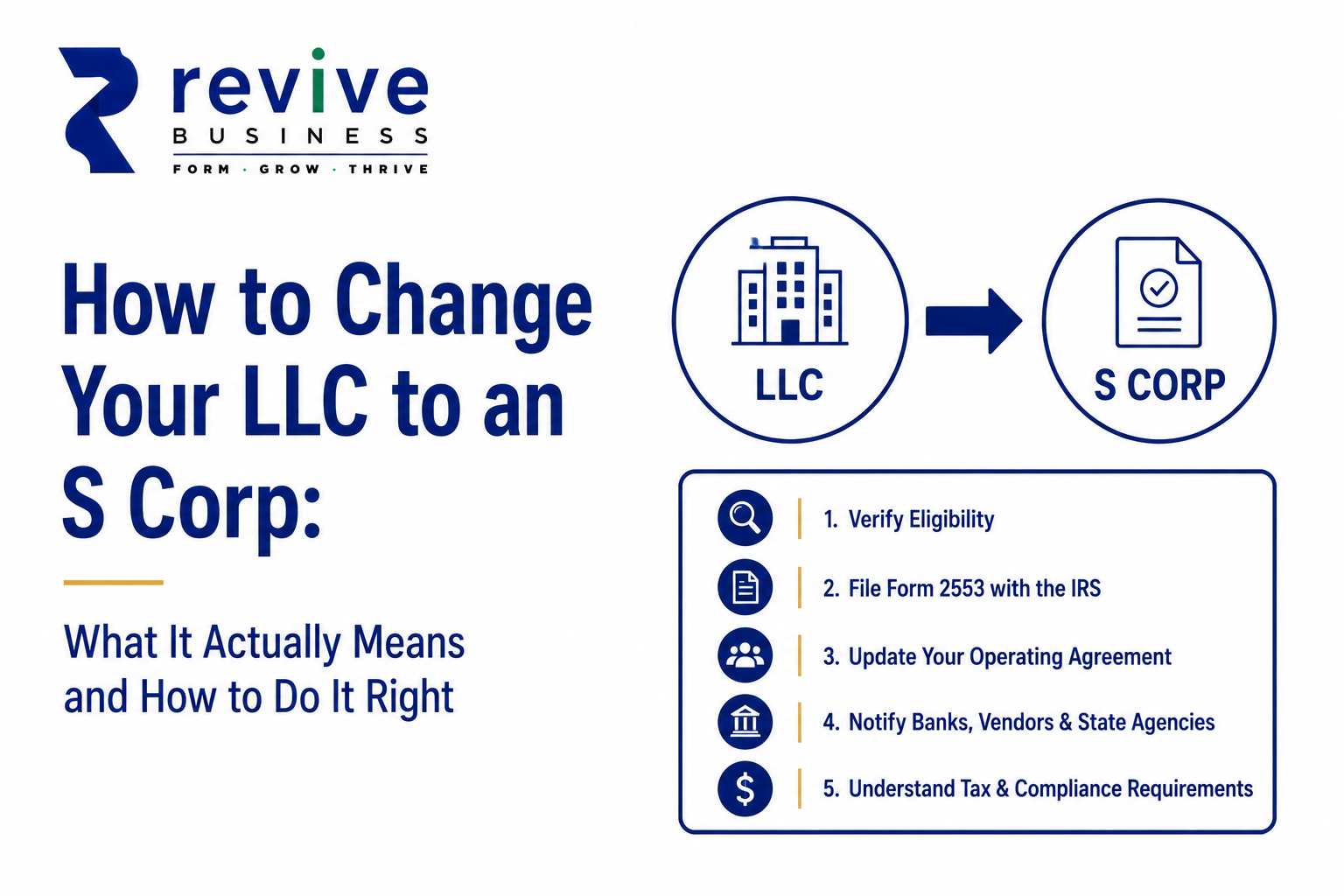
Electing S corporation tax treatment for your LLC is one of the most commonly recommended strategies for business owners at that income threshold. It does not change your LLC into a different legal entity. Your LLC remains an LLC under state law. What changes is how the IRS taxes your business income, and that distinction is worth understanding clearly before you file anything.
This guide explains exactly what an S corp election does, who qualifies, how much it can save, what the filing process involves, and what ongoing obligations come with the election so you can make an informed decision rather than one based on advice that leaves out the full picture.
What Changing Your LLC to an S Corp Actually Means
When people talk about changing an LLC to an S corp, they are almost always referring to making an S corporation tax election with the IRS, not converting the LLC into a different legal business entity. This distinction matters because the two paths are very different in complexity, cost, and consequence.
An S corporation is not a business entity type under state law the way an LLC or a corporation is. It is a federal tax classification. When your LLC elects S corp status, it remains an LLC for all state law purposes. You keep your existing operating agreement, your existing liability protection, and your existing state registration. What changes is that the IRS now taxes your business under Subchapter S of the Internal Revenue Code rather than as a sole proprietorship or partnership.
There is a separate path where you actually convert your LLC into a corporation and then elect S corp status for that corporation, but this involves state-level conversion filings, potential tax consequences on the conversion itself, and a more complex ongoing compliance structure. For most small business owners, the simpler S corp election for an existing LLC is the appropriate approach and the one this guide focuses on.
Why Business Owners Make the S Corp Election
The primary motivation is self-employment tax savings. Under standard LLC taxation, every dollar of net profit is subject to self-employment tax at 15.3% up to the Social Security wage base, and 2.9% above that. This applies whether you withdraw the money or leave it in the business. For a business owner earning $120,000 in net profit, self-employment tax alone is approximately $17,000 per year before income tax is even calculated.
With an S corp election, the owner is required to pay themselves a reasonable salary for the work they perform in the business. That salary is subject to payroll taxes, which are structurally equivalent to self-employment tax. However, any remaining business profit above the salary is distributed to the owner as a distribution rather than wages, and distributions are not subject to self-employment or payroll tax.
Using the same $120,000 example, if a reasonable salary for your role is determined to be $60,000, you pay payroll taxes only on the $60,000 salary. The remaining $60,000 distributed as a profit distribution carries no payroll tax obligation. The savings on that $60,000 at the 15.3% self-employment rate is approximately $9,180 per year. After accounting for the added costs of payroll processing and tax compliance that come with an S corp election, net annual savings for a business at this income level typically range from $5,000 to $8,000.
The Reasonable Salary Requirement You Cannot Ignore
The IRS requires S corp owner-employees to pay themselves a reasonable salary for the services they provide to the business. This requirement exists specifically to prevent owners from paying themselves nothing in salary, taking all income as distributions, and avoiding payroll taxes entirely. The IRS actively monitors S corp returns for unusually low or zero owner salaries and has successfully challenged arrangements it considers unreasonable.
Reasonable salary is determined by what you would have to pay an unrelated third party to perform the same work. Relevant factors include industry compensation data for your role, the time you spend working in the business, the geographic market where you operate, and the profitability of the business. A web developer running a $150,000 revenue agency who pays themselves $20,000 in salary and takes $130,000 in distributions is almost certainly outside the bounds of what the IRS considers reasonable and is taking on audit risk.
Setting your salary too low to maximize tax savings is a short-term decision with long-term risk. Setting it too high eliminates the financial benefit of the election. Getting this number right, and documenting the rationale for it, is one of the most important steps in making the S corp election work correctly.
Who Qualifies for an S Corp Election
The IRS imposes specific eligibility requirements for S corp status. Your LLC must meet all of them to make a valid election.
The business must be a domestic entity, meaning it was formed under the laws of a U.S. state or territory. It cannot have more than 100 shareholders or members. All shareholders must be U.S. citizens or permanent residents. The business can have only one class of stock or, in the case of an LLC, equivalent ownership interests. Certain entity types including other corporations, partnerships, and most trusts cannot be S corp shareholders.
For most single-member LLCs and small multi-member LLCs with individual U.S. citizen owners, these requirements are straightforward to satisfy. The eligibility concern that most commonly disqualifies a business is having a member who is a non-resident alien, having another business entity as a member, or having more than 100 members.
When to Make the S Corp Election: Income Thresholds That Matter
The S corp election is not beneficial at every income level, and making it too early can cost more in added compliance expenses than it saves in payroll taxes. Most tax professionals recommend evaluating the election when your net business profit consistently exceeds $40,000 to $50,000 per year, with the clearest financial benefit emerging above $80,000 in annual net profit.
The added costs of S corp status include payroll processing expenses, payroll tax filing obligations, quarterly estimated payments, an annual corporate tax return on Form 1120-S, and potentially higher bookkeeping costs to support the more complex financial reporting. At lower income levels, these added costs can exceed the payroll tax savings, making the election financially counterproductive.
Before making the election, calculate the expected payroll tax savings based on your realistic reasonable salary figure, then subtract the projected additional compliance costs. If the net savings are meaningful and consistent, the election makes financial sense. If they are marginal, the complexity may not be worth it yet.
How to File Form 2553 to Make the S Corp Election
The S corp election is made by filing IRS Form 2553, Election by a Small Business Corporation, with the IRS. For the election to apply to the current tax year, the form must be filed by the 15th day of the third month of that tax year. For a calendar-year LLC, that deadline is March 15. If you miss the deadline, the election typically takes effect for the following tax year.
The IRS does provide relief for late elections in certain circumstances, particularly when the failure to timely file was due to reasonable cause. If you intended to make the election for the current year but missed the deadline, it is worth consulting a tax professional about whether late election relief applies to your situation before assuming you must wait until the following year.
Form 2553 requires the LLC name and address, the EIN, the tax year the election should take effect, the names and signatures of all members or shareholders, and confirmation that each member meets the eligibility requirements. The form is mailed or faxed to the IRS service center designated for your state. There is no filing fee for Form 2553.
After filing, the IRS will send a CP261 notice confirming your S corp election has been accepted. Save this notice permanently. You will need it if the IRS ever questions your tax treatment in a future year or if you need to verify your election status when working with a new accountant or lender.
What Changes After You Make the S Corp Election
Once your LLC is taxed as an S corp, several operational and compliance changes take effect immediately. Understanding these before you file the election prevents surprises after it is approved.
You are required to run payroll and pay yourself a reasonable salary through a formal payroll system. This means setting up payroll, withholding federal and state income taxes, withholding the employee portion of Social Security and Medicare taxes, paying the employer portion of those taxes, filing quarterly Form 941 payroll tax returns, and issuing yourself a W-2 at year end. These are non-negotiable obligations that cannot be skipped or deferred.
You must file an annual Form 1120-S, the S corporation tax return, in addition to your personal tax return. The 1120-S reports the business income and expenses, and a Schedule K-1 is issued to each member reflecting their share of income, deductions, and credits. Each member then reports their K-1 income on their personal return. The 1120-S is due March 15 for calendar-year S corps, one month earlier than the April 15 personal return deadline.
Your bookkeeping requirements increase significantly. The separation between salary payments, payroll tax deposits, profit distributions, and business expenses must be meticulously tracked. Sloppy books make S corp compliance genuinely difficult and increase the risk of errors on the 1120-S that trigger IRS scrutiny.
State-Level Considerations for the S Corp Election
The federal S corp election does not automatically apply at the state level in every state. Most states recognize the federal S corp election and apply the same pass-through tax treatment, but several states either do not recognize S corp status at all or impose an additional entity-level tax on S corps.
California is the most notable example. California charges S corps a 1.5% tax on net income with a minimum annual tax of $800. New York City imposes a general corporation tax on S corps operating within the city that can significantly reduce the federal savings. Illinois, New Hampshire, and Tennessee also have state-level taxes that affect S corp income in ways that vary from the federal treatment.
Before making the election, confirm how your specific state treats S corps and factor any state-level tax into your savings calculation. An election that saves $8,000 in federal payroll taxes but triggers $5,000 in additional state taxes is a very different proposition than one where state treatment mirrors the federal benefit.
Frequently Asked Questions
Does making an S corp election change my LLC into a corporation?
No. Your LLC remains an LLC under state law. The S corp election only changes how the IRS taxes your business income. You keep your existing operating agreement, liability protection, and state registration exactly as they are.
When is the deadline to file Form 2553?
For the election to take effect for the current tax year, Form 2553 must be filed by the 15th day of the third month of that tax year. For a calendar-year LLC, that is March 15. Elections filed after this date generally take effect for the following tax year unless the IRS grants late election relief.
What is a reasonable salary for an S corp owner?
Reasonable salary is what a similarly qualified person would be paid to perform the same work in the same market. It is determined by industry compensation data, the nature and volume of your work in the business, and the profitability of the business. Setting it too low creates IRS audit risk. Setting it appropriately protects your election and keeps your books defensible.
Can I reverse the S corp election if it is not working for my business?
Yes, but with restrictions. You can voluntarily revoke an S corp election by filing a statement of revocation with the IRS signed by shareholders holding more than 50% of the shares. Once revoked, the business generally cannot re-elect S corp status for five years without IRS consent. Revoking an election is a decision that warrants careful consideration and professional guidance before taking action.
Do I still need to file a personal tax return after making the S corp election?
Yes. The S corp files its own tax return on Form 1120-S by March 15, and each member receives a Schedule K-1 reflecting their share of income, deductions, and credits. Each member reports their K-1 income on their personal tax return, which is still due April 15 or October 15 with an extension.
Ready to Evaluate Whether an S Corp Election Makes Sense for Your Business?
The S corp election is one of the most impactful tax decisions a growing business owner can make, and it is also one of the easiest to get wrong. Setting an unreasonable salary, missing the Form 2553 deadline, failing to run payroll correctly, or making the election at the wrong income level all undermine the benefit or create compliance problems that cost more to resolve than they saved.
Whether your LLC was just formed or has been operating for years, having the right structure and tax strategy in place from the beginning makes every subsequent decision easier. If you are evaluating the S corp election alongside your initial formation, our LLC formation services can help ensure your entity is set up correctly before any tax election is made.
Reach out to the team at Revive Business today and let us help you determine whether the S corp election is the right move for your business, and if it is, handle the process correctly from filing Form 2553 through ongoing payroll and compliance management.