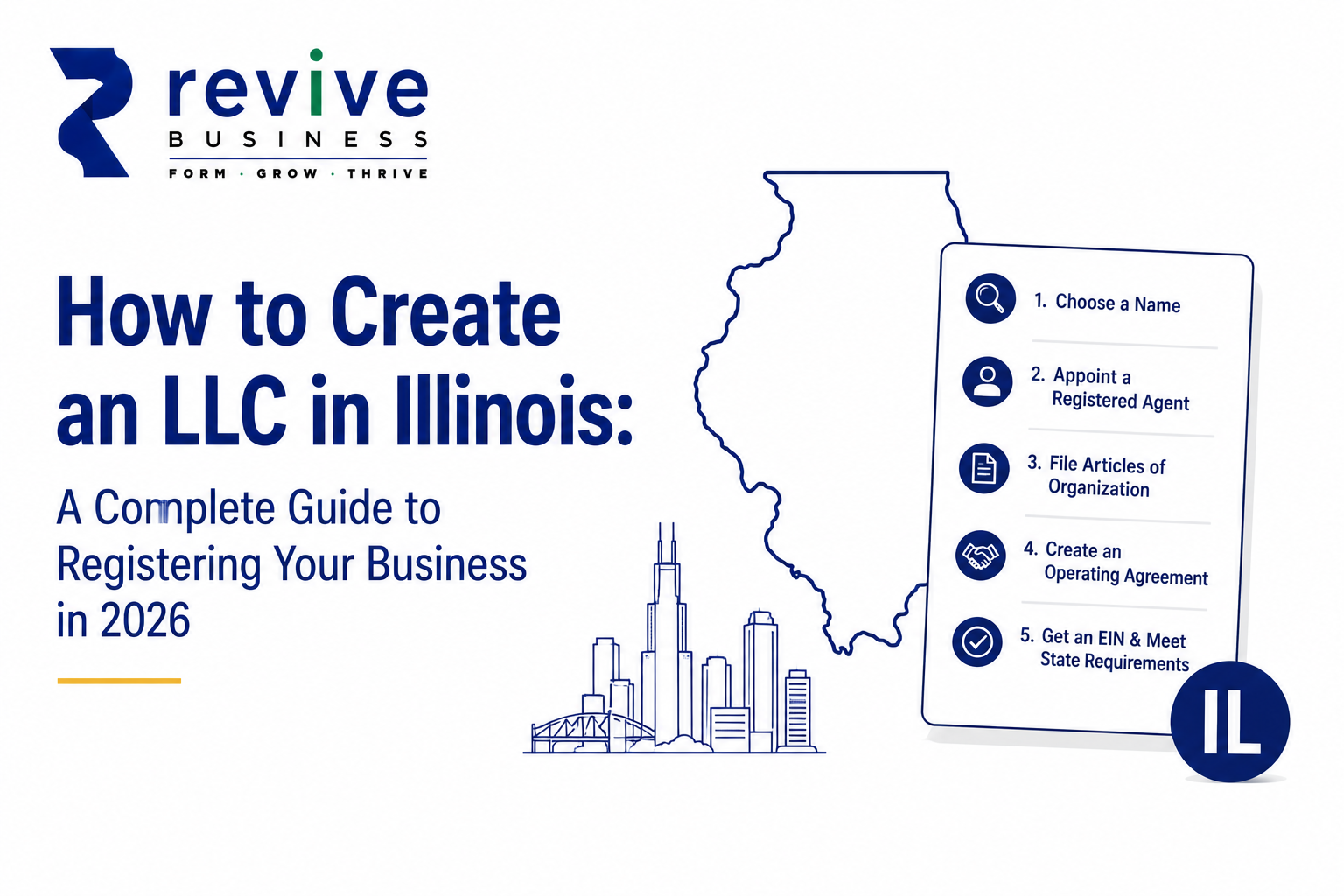
How to Create an LLC in Illinois: A Complete Guide to Registering Your Business in 2026
Learn how to create and register an LLC in Illinois step by step. Covers Articles of Organization, fees, registered agent rules, taxes, and annual reporting.
Illinois is home to one of the largest economies in the United States. Chicago alone ranks among the top business cities in the country, and the broader state economy spans manufacturing, technology, agriculture, financial services, and professional services in ways that create genuine opportunity for small business owners across every industry.
Forming an LLC in Illinois gives you the liability protection, tax flexibility, and professional credibility your business needs to operate confidently in that environment. The registration process is manageable when you understand what is required and in what order. What tends to create problems is not the process itself but the gaps, missing a compliance step, appointing an unqualified registered agent, or overlooking a state tax obligation before the first sale.
This guide walks through every step of the Illinois LLC formation and registration process with the specific fees, deadlines, and state requirements that apply in 2026.
What to Know About Illinois Before You File
Illinois has a competitive business environment but it is worth understanding the cost structure before you commit to forming here. The Articles of Organization filing fee is $150, which is higher than many Midwestern states. Illinois also charges an annual report fee of $75 per year. These are not prohibitive costs, but they are meaningfully higher than states like Kentucky ($40 filing, $15 annual) or Iowa ($50 filing, $30 biennial), so factor them into your startup budget.
Illinois imposes a flat income tax rate of 4.95% on individuals, which applies to pass-through income from LLCs. There is no franchise tax on LLCs specifically, but the Personal Property Replacement Tax applies to most LLCs and is calculated as 1.5% of net income. This is an Illinois-specific obligation that surprises many new LLC owners who assumed their only income tax exposure was at the personal level.
For business owners who live and operate in Illinois, forming here is the right practical decision. Forming in Wyoming or Delaware and then registering as a foreign LLC in Illinois adds cost and complexity without providing meaningful operational benefit for most small businesses.
Step 1: Choose a Name for Your Illinois LLC
Your LLC name must be distinguishable from every other business entity already registered in Illinois. It must include a designator such as Limited Liability Company, LLC, or L.L.C. Names that imply a government affiliation are not permitted, and certain restricted words such as Bank, Insurance, Attorney, and University require additional licensing or written approval before they can be incorporated into an LLC name.
Search the Illinois Secretary of State business name database before committing to any name. This search is free and confirms whether your chosen name is available for registration. If you find an available name but need time before filing, Illinois allows you to reserve it for 90 days by submitting a Name Reservation application with a $25 fee.
Run a domain name search at the same time you check business name availability. A business name with no matching domain creates a branding gap that becomes harder to resolve the longer the business operates. Resolving it before you file is far simpler than rebranding after you have built recognition around a name.
Step 2: Designate a Registered Agent in Illinois
Every LLC registered in Illinois is required to maintain a registered agent throughout the life of the business. The registered agent receives legal documents, government correspondence, and official state notices on behalf of your LLC. They must have a physical Illinois street address, not a post office box, and must be available at that address during all normal business hours.
You are permitted to serve as your own registered agent if you have a qualifying Illinois address and can be consistently present during business hours. The practical drawbacks are significant. Your registered agent address becomes part of the publicly searchable Illinois business record. If that address is your home, your personal address is attached to your business filing permanently. If you are away from the address when a legal document arrives, you may miss a filing deadline or a lawsuit notice entirely.
Working with a professional registered agent service keeps your personal address off the public record and ensures that every legal notice, tax document, and state correspondence is received and forwarded to you promptly regardless of your schedule or location. Annual costs typically run between $50 and $150, which is a straightforward investment given the consequences of missing a single legal notice.
Step 3: File Your Articles of Organization with the Illinois Secretary of State
The Articles of Organization is the formation document that officially creates your LLC under Illinois law. You file it with the Illinois Secretary of State through the online filing system, by mail, or in person at a regional office. Online filing is the recommended approach for most applicants because it is faster, provides immediate submission confirmation, and reduces the risk of processing errors from handwritten or mailed forms.
The state filing fee is $150 for standard processing. Expedited processing is available for an additional fee of $100, bringing the total to $250 for faster approval. Standard processing typically takes between five and ten business days for online submissions. If your business has a specific launch date, account for this processing window when planning your timeline.
Your Articles of Organization will require your LLC name and principal office address, the name and address of your registered agent, a statement of whether the LLC is member-managed or manager-managed, the names and addresses of your organizers, and the purpose of the LLC, which can be stated generally as engaging in any lawful business activity.
Once the Secretary of State approves your filing, you will receive a stamped copy of your Articles of Organization. Store this document securely along with any other formation paperwork. You will need it to open a business bank account, apply for financing, and verify your LLC's legal existence with vendors, clients, and government agencies.
Step 4: Create an Operating Agreement
Illinois does not legally require LLCs to have an operating agreement, but this is consistently one of the most important documents an LLC owner can put in place. Without an operating agreement, your LLC is governed entirely by Illinois default LLC statutes under the Illinois Limited Liability Company Act, and those defaults may not align with how you actually intend to run the business or divide its ownership.
A thorough operating agreement should address ownership percentages and each member's capital contributions, how profits and losses are allocated and distributed, voting rights and the process for making major business decisions, procedures for admitting new members or handling a member's departure, and the process for dissolving the LLC if that becomes necessary.
For single-member LLCs, an operating agreement serves as evidence to banks and courts that the business is a genuine separate legal entity and not simply an extension of your personal finances. This distinction matters when you are seeking financing and when your liability protection is ever challenged in a legal proceeding.
Step 5: Obtain Your EIN from the IRS
An Employer Identification Number is a federal tax identification number that your LLC needs to open a business bank account, hire employees, file federal and state tax returns, and apply for business licenses and permits in Illinois and elsewhere. The application is completely free through IRS.gov, takes approximately ten minutes to complete online, and returns your EIN number immediately upon submission.
Getting an EIN is recommended for every LLC regardless of whether you have employees. It keeps your Social Security Number off vendor contracts, banking documents, and tax paperwork, which reduces your personal identity theft exposure and signals to clients and financial institutions that your business has a proper structure in place.
Step 6: Handle Your Illinois Tax Registrations
Illinois has a state sales tax rate of 6.25% on the sale of tangible personal property. Many local jurisdictions in Illinois add additional local taxes on top of that rate, making the combined rate in Chicago 10.25% and in many other municipalities considerably higher than the base state rate. If your LLC sells taxable goods or qualifying services, you must register for a sales tax permit with the Illinois Department of Revenue before your first taxable sale.
Completing your sales tax registration through the MyTax Illinois portal is a separate process from filing your Articles of Organization. Many new Illinois LLC owners make the mistake of assuming their formation filing covers all state registrations. It does not. Operating without a sales tax permit when one is required exposes your business to back taxes, penalties, and interest that can accumulate over multiple years before they are discovered.
If your LLC has employees, you must also register for Illinois withholding tax with the Illinois Department of Revenue before your first payroll cycle. Illinois has a flat individual income tax rate of 4.95%, and employers are required to withhold this amount from employee wages and remit it to the state on a schedule determined by your withholding volume.
The Personal Property Replacement Tax is an additional Illinois-specific obligation that applies to most LLCs. It is calculated at 1.5% of net income and is filed annually with your Illinois income tax return. Unlike a franchise tax, this is not a flat fee but a percentage of actual earnings, so its impact grows as your business becomes more profitable.
Step 7: Open a Dedicated Business Bank Account
Opening a business bank account as soon as your EIN is confirmed is one of the most important practical steps in the LLC formation process. Keeping your business and personal finances completely separate is what preserves the liability protection your LLC is designed to provide. Using personal accounts for business transactions gives courts grounds to disregard your LLC's legal separation and hold you personally responsible for business debts.
Most Illinois banks will require your stamped Articles of Organization, your EIN confirmation letter, a government-issued ID, and sometimes your operating agreement to open a business account. Having all of these documents organized and ready before visiting a branch or completing an online application speeds up the process considerably.
Illinois LLC Annual Report Requirements
Illinois LLCs are required to file an annual report with the Secretary of State each year. The filing fee is $75, and the report is due before the first day of the anniversary month of your LLC's formation. For example, if your LLC was formed in March, your annual report is due by March 1 of each subsequent year.
Missing the annual report deadline results in your LLC being placed in bad standing with the state. Continued non-compliance can lead to administrative dissolution. Reinstatement after dissolution involves filing overdue reports, paying penalties, and working through a reinstatement process that takes time and costs more than the original compliance would have. Set your annual report reminder well in advance of the due date each year.
Getting Professional Help with Your Illinois LLC Registration
Many Illinois entrepreneurs choose to work with professional LLC formation services to handle the Articles of Organization filing, registered agent designation, and initial compliance setup. The value is not that the process is technically difficult but that errors in formation documents cause delays, and missing early compliance steps creates problems that compound over time. Getting it right from the start is consistently less expensive than correcting mistakes after the business is operating.
Common Mistakes When Creating an LLC in Illinois
Choosing a business name without confirming availability first is a preventable error that delays your entire formation timeline. Always run the Secretary of State name search before you submit anything.
Skipping the operating agreement leaves your LLC governed by Illinois default statutes. This creates real problems when member disputes arise, when a lender asks for governance documentation, or when your liability protection is challenged in a legal proceeding.
Overlooking the Personal Property Replacement Tax catches many Illinois LLC owners by surprise. This is not a well-publicized obligation and it applies even in years when the business has modest profits.
Missing the annual report deadline based on the anniversary month rather than a fixed calendar date like January 1 or April 15 is a common error. Illinois uses the anniversary month system, so your due date depends entirely on when your LLC was formed.
Commingling personal and business funds eliminates the liability protection your LLC was formed to provide. Open a dedicated business account and maintain that separation consistently from the first day of operation.
Frequently Asked Questions
How much does it cost to register an LLC in Illinois?
The standard Articles of Organization filing fee is $150. Expedited processing costs an additional $100. Optional costs include a name reservation ($25 for 90 days), registered agent service ($50 to $150 per year), and the $75 annual report fee. Most first-year formations cost between $250 and $400 depending on the services used.
How long does it take to form an LLC in Illinois?
Standard online processing takes five to ten business days. Expedited processing is available for an additional $100 fee and typically results in approval within one to two business days. Mail filings take considerably longer and are not recommended when speed matters.
Does Illinois require an operating agreement for an LLC?
Illinois law does not require an operating agreement, but every multi-member LLC should have one and single-member LLCs benefit significantly from having one in place. Without it, your LLC operates under Illinois default statutes that may not reflect your actual intentions or business arrangement.
What is the Personal Property Replacement Tax in Illinois?
The Personal Property Replacement Tax is an Illinois-specific tax of 1.5% on net income that applies to most LLCs. It replaced the old personal property tax and is filed annually with your Illinois income tax return. It applies regardless of business structure and is separate from your individual income tax obligation on pass-through earnings.
When is the Illinois LLC annual report due?
The annual report is due before the first day of the anniversary month of your LLC's formation. The fee is $75 per year. Missing this deadline results in bad standing with the state and can eventually lead to administrative dissolution if the filing remains overdue.
Can a non-Illinois resident form an Illinois LLC?
Yes. Non-residents can form and own an Illinois LLC without residing in the state. You will need a registered agent with a physical Illinois address to accept legal documents on behalf of the business. If you are operating primarily in another state, consider whether registering as a foreign LLC there will also be required.
Ready to Register Your LLC in Illinois?
Illinois offers a strong business environment with a clear and manageable registration process once you understand each requirement. The $150 filing fee and $75 annual report place it at a higher cost than some neighboring states, but for business owners actually operating in Illinois, forming here is the practical and financially sensible decision.
At Revive Business, we help Illinois entrepreneurs get every step right from the start. Reach out to our team today and let us handle the registration process while you focus on building your business.