How to File Taxes for an LLC With No Income
Active LLC with zero revenue? Learn federal filing requirements for single and multi-member LLCs, write-offs, and state fees to remain compliant.
Tax time is a time when many LLC owners hit pause, especially if the business hasn't generated any income. The reasoning is: if someone doesn't have any income, they don't have to file, and there is no problem. This is a good guess, but it can cause actual compliance nightmares.
The reality is that there are no income LLC tax obligations that simply go away due to a lack of activity in your company. Even though you have an LLC, you may still have to file federal and/or state-level documents, depending on the nature of your business and where your LLC is registered. If you make this mistake, even if accidentally, it may lead to penalties, late fees, or loss of good standing for your LLC.
What you need to know:
Does an LLC With No Income Need to File Taxes?
It depends; that's the short answer.
LLC tax filing requirements aren't one-size-fits-all. IRS does not impose the same tax treatment on all LLCs, as LLCs are presumed to be "pass-through" entities, which means that the tax treatment passes through to the owner(s). This will depend on the classification of your LLC.
3 elements determine filing requirements:
-
Whether your LLC is a disregarded entity, partnership, S corp, or C corp.
-
Federal IRS guidelines based on that category
-
The state's inactive or dormant LLC guidelines.
All of these may be a source of stand-alone filing requirements -- and any one of them may be applicable even if your business wasn't generating any income.
Filing Requirements by LLC Type
Single-Member LLC
The single-member LLC is presumed to be a disregarded entity. This means that the IRS does not view it as its own tax filer, but rather the activity (or lack thereof) of your business is reported on your personal tax return on Schedule C, attached to Form 1040.
If your LLC was 0-0 (no income and no expenses), it's possible that you don't need a Schedule C. If you had any deductible expenses, including startup expenses or business subscriptions, you should still report them, even if you have a deductible.
The important thing to remember: You still have to file your personal income tax return. There's no choice but to take a seat.
Multi-Member LLC
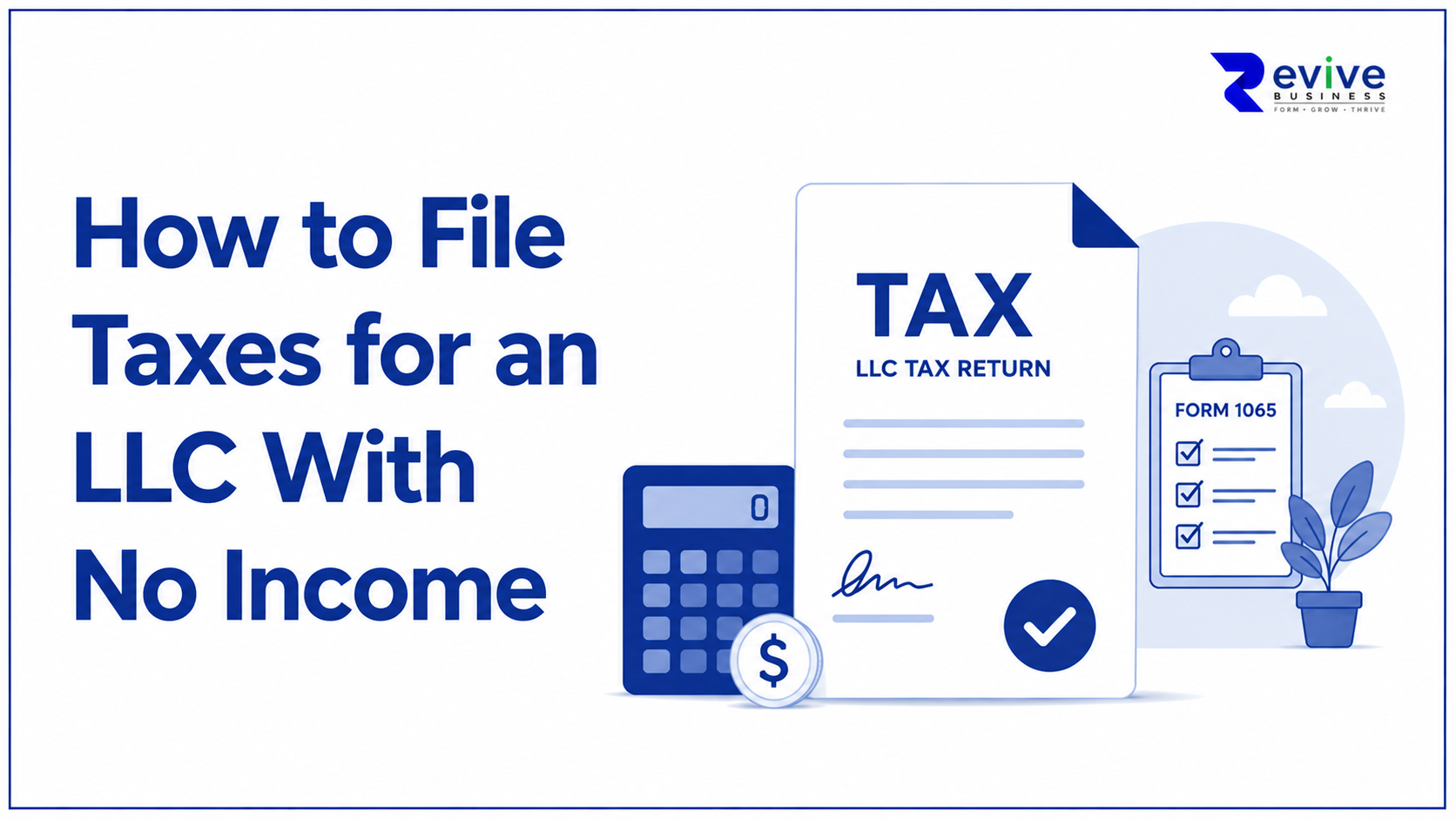
Multi-member LLCs are assumed to be partnerships. The partners must file Form 106, U.S. Return of Partnership Income, even if they did not generate any income for the year.
This is a difficult IRS requirement. If you have a partnership LLC, it will be subject to penalties of $235 per partner per month for up to 12 months if you do not file Form 1065. That can add up real quick with two or three other partners.
LLC Taxed as an S Corporation
An S corporation LLC is required to file Form 1120-S each year, even if it didn't earn any income. Under this classification, there is no dormancy exception for LLC taxes.
Each shareholder will also be issued a Schedule K-1 that will be reported on his/her personal tax return.
LLC Taxed as a C Corporation
If an LLC is taxed as a C corporation, then it will file a Form 1120, a corporate income tax return. This filing is also due each year, even if there is no income.
There will also be minimum tax requirements, if any, in various states for corporations.
State Filing Obligations Still Matter
Federal taxes are not the only ones. States have their own rules, and they're not necessarily as generous as you might think for an LLC that doesn't have any cash flowing in.
Many people who start businesses, but never act to grow them, don't realize this:
-
Most states require annual reports, including dormant ones. Failure to do so may result in the LLC being out of good standing or even being administratively dissolved.
-
Many states require franchise taxes based on income. In California, the minimum annual LLC franchise tax is $800 for an active LLC, whether or not it made any money.
-
The price of minimum state fees varies significantly. Certain states have set up one-time fees to maintain your LLC. Some have a tiered fee system.
-
It's not about compliance if an LLC is inactive. In most states, not filing an LLC doesn't mean that you don't exist. The filing requirements continue to run.
By failing to meet obligations in a state with strict LLC filing requirements, you may end up paying penalty fees, facing personal liability risks, or having to have your LLC formally reinstated later.
Common Mistakes LLC Owners Make
An LLC can be dormant for a year without much effort being put into compliance. The following mistakes are most likely to give you problems:
-
Myth: If you don’t have income, you don’t need to file taxes. This is not the case for partnerships, S corporations, or C corporations, and even a single-member LLC can have obligations on the state level.
-
Failure to file state reports. Annual reports and payments of franchise taxes are due on specific dates. These deadlines can slip by without a reminder system, especially if you haven't been involved with your LLC recently.
-
Not keeping records. Financial records should be maintained even if the business is not earning any money. The proof of business activity (or lack of) and bank statements and expense records will be requested by the IRS if you are ever selected for an audit. This is why bookkeeping for new businesses is important before any revenues flow in.
-
Ignoring IRS notices. The IRS can send a notice or make a substitute return (typically not on your behalf) if it concludes you should have filed a return and you didn't.
-
Failure to understand how LLCs can be taxed. Not many LLC owners know about the tax status of their LLC. Understanding LLC tax classifications is essential to understanding what, when, and how much you owe.
Real-World Filing Scenarios
Scenario 1: A New LLC That Failed
You formed an LLC in the spring with plans to start a consulting business. Life intervened, and by the end of the year, the business had no customers. No income, no invoices, no expenses.
What may still be applicable:
-
You were probably still required to submit an annual report or fee to your state.
-
A multi-member LLC will have to file Form 1065 at the federal level.
If it's an inactive one-member LLC, it might not be required to file a federal document, but check the requirements in your state.
Scenario 2: Side Business LLC With No Revenue
You started an e-commerce LLC with a website subscription, ordered products, and paid for some ads, and ended up with no sales all year long.
What may still be applicable:
-
Those start-up and operating costs could be deductible...IF they're reported on the right form.
-
If it's a single-member LLC, it would use Schedule C and may report a loss.
-
Where a multi-member LLC still has to file Form 1065, those expenses have to be reported on that form.
It's actually a situation in which filing may be beneficial, because losses might offset other earnings.
Why Proper Recordkeeping Matters
Organized financial record-keeping is essential, even if a business is not making a profit.
Properly keeping books helps you establish good habits for new business owners. If your business expenses are low or even if you don't have to use your own name, having a separate personal account and using your LLC's name for business transactions maintains your legal protections and makes future filings much easier.
Bookkeeping for small business owners doesn't need to be difficult. At minimum:
-
Open a business bank account.
-
Record all payments that are made for the LLC.
-
Keep receipts and record business transactions.
-
Record the dates of your LLC's official formation and the beginning of any activity.
These records serve as your first line of defense in case your LLC is ever audited, whether it is years later. And if the business is later expanded, the historical financial records will already be clear.
Work With a Filing Expert Before You Assume You're in the Clear
If your LLC did not generate any income this year and you're not sure what forms to file, don't take a chance.
There is almost always a negative outcome if you miss a filing, penalties, loss of good standing, or an IRS notice.
Whether your LLC is brand new, inactive, or just seeking to take a deep breath and begin, Revive Business Filing offers expert tax return filing services for LLCs at any point. We explain precisely what is needed according to your LLC's tax classification, your state's laws, and your situation.
From simple dormant LLC formation to complex compliance guidance, we're here to ensure your business remains compliant without the hassle.
Get in touch with Revive Business Filing today, and let's make sure your LLC is covered.
Frequently Asked Questions
Do I need to file taxes for an LLC with no income?
Often yes. Multi-member LLCs must file Form 1065. S and C corp LLCs file annually regardless. Single-member LLCs should verify state requirements.
What are the consequences of not filing taxes for an inactive LLC?
The IRS will assess $235 monthly for each partner for any unreturned partnership. You can have your LLC dissolved by your state, and they may impose reinstatement fees.
Does a one-person LLC have to file a return if it does not make any revenue?
If there was no activity, there was no federal activity. However, if costs do occur, be sure to submit Schedule C. State filings will be applicable separately.
Do states still charge fees for inactive LLCs?
Yes. Most states mandate reports and fees for all income, regardless of income. California has a minimum $800 Franchise Tax fee for dormant LLCs.