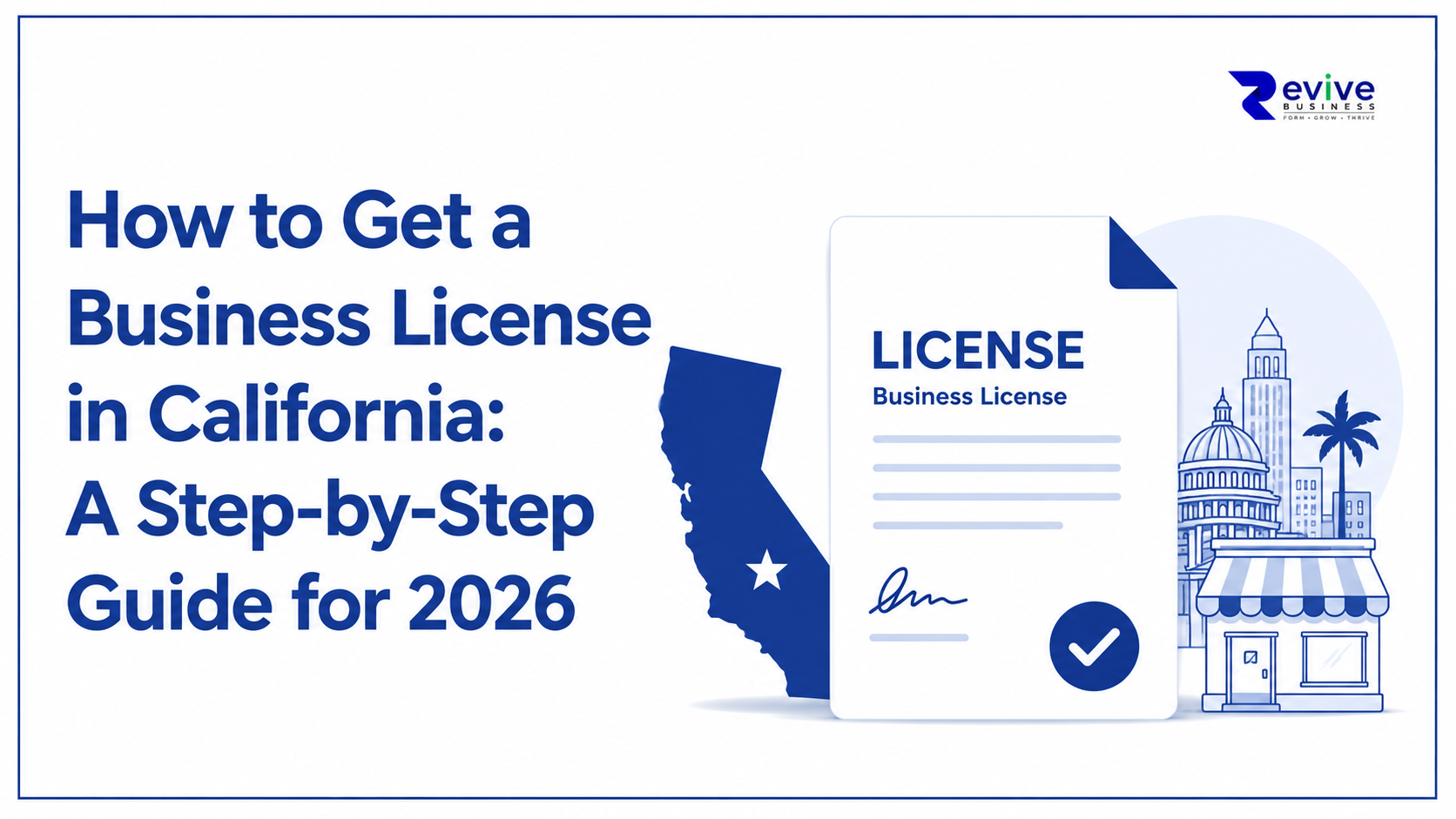
How to Get a Business License in California: A Step-by-Step Guide for 2026
Learn how to get a business license in California in 2026 with this step by step guide covering requirements, costs, permits, and filing tips.
So, you've decided to start your business in California. Well done, the state has one of the world's most dynamic economies. However, before you open your doors (or go online), you have a practical question to answer: "Do I need a California business license and how can I acquire one?"
Yes, most businesses in California require a business license or permit. The longer answer will depend on the item you are selling, the location of your business, and the structure of your business.
This guide takes you through the process, step by step, with clarity and without all the legal mumbo-jumbo. This is your blueprint for starting a business in San Diego or Los Angeles as an entrepreneur or even moving on to start an e-commerce company.
What is a California Business License, and Do You Really Need One?
One thing that surprises many first-time business owners is that California does not have a general business license for the entire state. There is no universal application to fill out, and you are then “licensed” to operate in every state; that isn't the case in some.
Rather, there are two levels of licensing in California:
-
Local licenses: These are licenses that are issued by your city or county, sometimes referred to as a “business tax certificate.”
-
Professional Licenses: Applies to certain regulated professions; State Licenses: Applies to certain professions regulated by the state.
Suppose you are opening a mobile dog grooming business in Pasadena. You would need a city business license from Pasadena’s City Hall, and depending on your services, possibly a health permit from the county. If you have employees on staff, you would also be required to register for state payroll taxes.
Licensing is a matter of puzzle pieces that depend on your job, your locale, and your business entity. That's why it's so helpful to work with a filing service such as Revive Business to save hours of confusion and to help you avoid costly compliance pitfalls.
Step 1: Select and Register Your Business Structure.
In order to obtain any licenses, one has to formalize his/her business. The type of structure you select can impact your liability coverage, tax liabilities, and much more.
The most popular in California are:
-
A sole proprietorship is the easiest to establish, but offers no personal liability protection.
-
Partnership: Liability is shared, easy to form for co-owned businesses
-
Register a California LLC: For small business owners, the most popular option for registering is the California Limited Liability Company (LLC). It provides liability protection and flexibility in tax treatment.
-
C Corporation (also known as S Corporation): Opt for this if they are looking to raise investment or issue shares.
The steps to register a California LLC include submitting Articles of Organization to the California Secretary of State and paying the $70 filing fee. One will also need to designate a registered agent (more on that to come).
LLCs in California are required to pay a minimum $800 annual franchise fee (no matter if they make a profit or not). Plan for this in your start-up budget.
Step 2: Appoint a California Registered Agent
All LLCs and corporations are required to have a registered agent, who is someone or a business entity in California that accepts legal and official government documents for your business.
While self-employment as a registered agent may be a viable option, there are certain disadvantages. Your name and address are placed in the public record, and you are required to be at the address at some time during the business day to receive documents sent there. This is not an option for most business owners.
This is where a professional California registered agent service comes into play. It shields your privacy, helps you avoid missing key legal notifications, and ensures your business is in good standing with the state.
Revive Business provides a secure California registered agent service for businesses that can keep you in compliance while you build your business. Learn more here.
Step 3: Apply for Your Local Business License
So, after registration of your business, it's time to obtain your local license. This is the most common type of permit and applies to nearly all businesses in California.
How It Works
There are a variety of processes for each city and county, but here is a general outline:
-
Identify the correct office; this is typically the Finance Department, Business Tax Office, or City Clerk's office of the city.
-
Online portals are now becoming increasingly common in most major California cities:
-
Take care to pay the licensing fee.
-
Get and hang up your license if needed
Real-World Example
Let's say you're starting a marketing firm that's based out of your home in Sacramento. You would go to the City of Sacramento web portal, fill out a business license application, and pay a fee depending on your gross receipts. If the paperwork is in order, it will take 10-15 minutes.
Local licences were to be renewed annually, as the majority of them did. Failure to renew on time may lead to fines and/or loss of license, so schedule a reminder on your calendar the day you receive your first certificate.
Step 4: Register for California Sales Tax (If You Sell Taxable Products or Services)
If your company sells tangible goods or some types of services in California, you must pay and withhold sales tax. This is done by registering for tax with the California Department of Tax and Fee Administration (CDTFA).
A seller's permit will be required and is free to obtain. Once approved, you’ll be required to:
-
Accurately calculate the correct city/county sales tax rate for the customers (this is different in each city and county)
-
Complete monthly, quarterly, or annual sales tax returns, depending on how many sales you have.
-
Pay the state taxes that are collected on time.
E-commerce sellers are also subject to the California sales tax registration. When you're making online sales to customers in California, even if your warehouse or office is in a different state, you may have sales tax obligations. This is called “economic nexus,” and California's benchmark is $500,000 in sales to California residents over 12 months.
This is a very expensive oversight. The CDTFA is actively auditing businesses, and penalties, interest, and back taxes can be collected up to several years old if sales tax is not paid.
Step 5: Get Industry-Specific State Licenses (If Required)
Some occupations and/or industries have a State license in addition to the local license. These are not administered by your city or county; they are issued by particular state agencies.
Common examples include:
-
California Contractors State License Board (CSLB)
-
Real estate agents: California Department of Real Estate (DRE)
-
California Board of Barbering and Cosmetology: Cosmetologists and barbers.
-
Food businesses and restaurants, County Environmental Health Department
-
California Department of Alcoholic Beverage Control (ABC) Alcohol Sales data:
CalGold (calgold.ca.gov) is a helpful resource from the state that will create a tailored list of need-to-have permits for your business based on your type and location. Although this is a helpful starting point, it is always best to confirm with a professional for the most accurate and peace of mind.
How Much Is a Business License in California?
One of the top questions that new businesses search for, and rightfully so, is how much a business license costs in California. The truthful breakdown:
-
Local business license fees: These costs vary based on your city and the amount of your gross receipts, usually from $50 to $500+.
-
California LLC filing fee: $70 (one-time)
-
Annual LLC franchise tax: Minimum of $800 per year
-
The seller's permit (CDTFA) is a free one.
-
Registered agent service: $49–$299 annually, depending on the provider
-
Industry-specific licenses: wide range ( varies from $100 up to several thousand dollars, depending on the industry )
So, how much is a business license in California? In most cases, the total cost of all applicable licenses, registrations, and taxes (not including professional service charges) will range from $500 to $1,500 for the first year of operation for most small businesses.
Practical Tips to Stay Compliant From Day One
It’s good to obtain a license, that’s one thing. Staying compliant is another. Here’s what successful business owners say:
-
Never operate before you’re licensed. Without a license, possible consequences include fines, closure, and the inability to enforce contracts.
-
Monitor all renewal dates. The majority of licenses are valid for 1 year. Penalties or suspension can be initiated if deadlines are not met.
-
Update your license if there are changes. If the location changes, new partners are added, or services are expanded, there may be amended filings that need to be done.
-
Maintain paper and electronic records. Certain businesses should have a license prominently displayed.
-
Use a trustworthy filing partner. Revive Business provides services that focus on maintaining California businesses' compliance from their inception to their continued business operations.
Frequently Asked Questions
Do I need to obtain a license to conduct a business in California?
In some cases, an activity, such as a very small or informal one, might not technically need a formal licence, but in most cases, operating without a licence is a huge legal and financial risk. Customer, competitor, or city inspector may point out a problem, which may result in fines or forced closure the next time you are inspected. Getting a license from the get-go is always best.
How long does it take to get a California business license?
Local business licenses are usually issued within 1-2 weeks, although many cities provide same-day or next-day online business license applications. State professional licenses may take months longer, particularly if they involve exams, background checks, fingerprinting, and more.
If you work from home, do you require a business license?
Yes. The majority of the cities in California still require a local business license for home-based businesses. Certain cities may also need a home occupation permit that verifies that your business use will not be a nuisance to neighboring residents.
What’s the difference between a business license and a seller’s permit?
The business license is a general license to conduct business in any particular city or county. A seller's permit is a state-level registration to allow you to collect and remit sales tax. For those who do sell taxable products or services, they most likely will require both.
Is a DBA not the same as a business license?
No. A DBA (Doing Business As), or a fictitious business name, is just a nickname for your legal business name. It is not a substitute for nor part of a business license. Either or both can be necessary based on your situation.
Ready to Get Your California Business License?
Getting licensed in California doesn't have to be a daunting task. Divide it up into steps, do one step at a time, and ask for help from professionals.
Whether you are just starting your business or you've been in operation for some time, California entrepreneurs should work with Revive Business to guide them through the entire licensing and registration process, including setting up your LLC, appointing a registered agent, and completing your sales tax registration, among other tasks.
We have assisted hundreds of business owners in getting up and running quickly and in compliance. From beginners to those who missed the deadline, we can make it easy.
➤ Visit Revive Business to get started today.