If a Trademark Is Dead, Can I Use It? What Business Owners Need to Know Before Assuming It Is Free
Can you use a dead trademark? Learn what USPTO "dead" status actually means, common law infringement risks, and how to safely register abandoned marks.
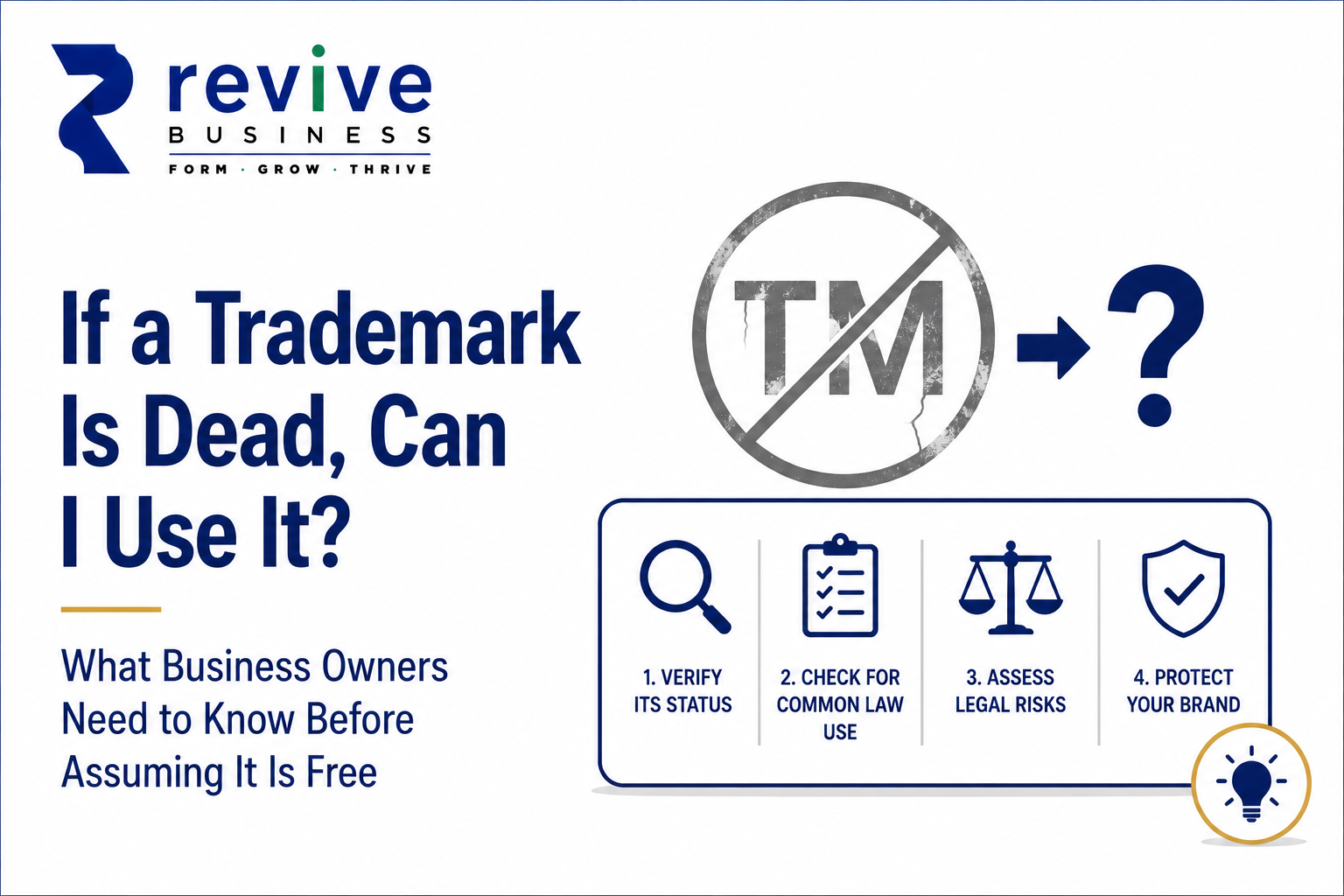
You searched the USPTO trademark database, found a name you want to use, and noticed its status shows as dead. Your first instinct is probably that you are in the clear and the name is available. That instinct is understandable, but it is not always correct, and acting on it without doing further research is one of the more common and costly mistakes new business owners make around intellectual property.
A dead trademark registration is not the same thing as a name with no legal protection. Understanding what dead status actually means, what rights may still exist around that mark, and what steps you need to take before using it is essential if you want to build a business around a name without legal exposure.
What Does Dead Trademark Status Actually Mean
When the USPTO marks a trademark registration as dead, it means the federal registration is no longer active. Federal trademark registrations can become dead for several reasons. The applicant abandoned the application during the examination process by failing to respond to an office action within the required timeframe. The registration was cancelled by the USPTO for failure to file required maintenance documents. The owner voluntarily surrendered the registration. A court ordered the registration cancelled following a successful challenge. The registration expired because the owner did not renew it.
In every one of these cases, the consequence is the same at the federal level. The registration no longer grants the owner the nationwide presumption of ownership, the right to use the registered trademark symbol, or access to federal court jurisdiction for infringement claims. The federal registration is gone.
What a dead registration does not mean is that all rights in the mark have disappeared. This is the critical distinction that many business owners miss entirely.
Common Law Trademark Rights Survive Federal Registration Status
In the United States, trademark rights arise from actual use in commerce, not from federal registration. Federal registration provides significant advantages, including constructive notice to the country, access to federal courts, and the ability to block infringing imports at the border. But a business that has been using a mark in commerce builds common law trademark rights in that mark from the moment of first use, regardless of whether it ever filed a federal application.
When a federal registration dies, those common law rights do not automatically die with it. If the original owner is still using the mark in commerce, they likely still have enforceable common law rights in the geographic area where they operate. Those rights are not visible in the USPTO database because they were never federally registered or because the registration is now dead, but they are legally real and can be enforced in state court or federal court if you start using the same or a confusingly similar mark in the same industry.
The scenario that trips up the most business owners is one where a company filed a federal application, the application went dead for administrative reasons, and the company has continued operating under that name for years. From your perspective searching the USPTO database, the trademark looks dead and available. From the company's perspective, they have been using the mark continuously and have strong common law rights that would survive any attempt by you to use the same name in the same market.
Why the Reason a Trademark Went Dead Matters
Not every dead trademark carries the same level of risk, and the reason it went dead gives you important information about how to evaluate the situation.
A trademark that went dead because the application was abandoned early in the process, before the mark was ever used publicly in commerce, is genuinely lower risk. If the applicant never launched the product or service associated with the mark, they may have no common law rights to assert because they never actually used the mark.
A trademark that went dead because the registration was not renewed after years of active use is a different situation entirely. The registration may be dead, but the business that used the mark for years likely still has substantial common law rights and ongoing consumer recognition. That is a mark you need to investigate carefully before using.
A trademark that went dead because the registrant was a company that is now genuinely defunct, has been dissolved, and has no successor in interest is closer to being freely available. But even here you need to verify that the business is truly gone and not simply operating under a different legal entity.
What to Check Before Using a Dead Trademark
Finding a dead registration in the USPTO database is the starting point of your research, not the end of it. There are several additional checks you should complete before making any business decision based on that mark being available.
Search for the Original Owner
Look up the original applicant or registrant and determine whether they are still in business. A basic web search, a state business registry search, and a review of their current online presence will tell you whether they are still actively using the mark. If the company is still operating and still using the name, you should treat the mark as if it were still federally registered from a risk perspective.
Search State Trademark Registries
Many states maintain their own trademark registration systems. A mark may have a dead federal registration but an active state registration that grants enforceable rights within that state. If your business will operate in a specific state, check that state's trademark database in addition to the USPTO system.
Assess the Likelihood of Confusion
Even if you establish that the original owner has no enforceable rights, consider whether your use of the same or similar mark in the same or related industry could create confusion in the marketplace. Trademark law is ultimately about protecting consumers from confusion about the source of goods and services. A court evaluating a trademark dispute looks at factors including the similarity of the marks, the similarity of the goods or services, the strength of the original mark, and the geographic overlap of the parties.
Search for Pending Applications
While you are in the USPTO database, search for any pending applications that include the same or similar mark in the same or related class of goods or services. A pending application that has not yet been approved could create a conflict with your use, particularly if that applicant achieves registration before you establish significant use in commerce.
Can You File a New Trademark Application for a Dead Mark
Yes, in many cases you can file a new application for a mark that carries dead status in the USPTO database. However, the dead status of a prior registration does not guarantee your application will succeed. The USPTO will still examine your application on its merits, and if they find evidence that the original owner has ongoing common law rights in the same or confusingly similar mark for the same or related goods and services, they may reject your application or a third party may oppose it.
Filing a trademark application is also not a prerequisite to using a mark. You can begin using a mark in commerce and build common law rights before filing. But filing an intent-to-use application or a use-based application establishes your priority date and puts others on notice of your claim, which is a meaningful advantage as your business grows.
The Practical Risk Assessment for Business Owners
For a business owner deciding whether to use a name associated with a dead trademark registration, the relevant question is not whether the registration is dead. The relevant question is whether using the name creates a meaningful risk of a legal dispute that would be costly to defend or that could force a rebrand.
A rebrand mid-business is expensive. You lose the brand equity you have built, you face costs to update every piece of marketing material, your website, your social profiles, and potentially your legal entity name, and you absorb the reputational confusion that comes from changing your business identity. Building on a name that was never properly cleared is a risk that surfaces at exactly the wrong time, when your business has grown enough to be worth going after.
The standard of care for a new business is a trademark clearance search that goes beyond the USPTO database. A comprehensive clearance search covers federal registrations, pending applications, state registrations, common law uses including business directories, domain registrations, and social media profiles, and an analysis of the likelihood of confusion with any marks found. If you are building a business around a specific name, the cost of a proper clearance search is trivial compared to the cost of a forced rebrand or a trademark infringement lawsuit.
Frequently Asked Questions
Does a dead trademark mean the name is in the public domain?
Not necessarily. A dead federal registration means the federal registration no longer exists, but common law trademark rights based on actual use in commerce may still be valid and enforceable. Verify whether the original owner is still using the mark before assuming it is freely available.
How long does it take for a dead trademark to become truly available?
There is no fixed period after which a dead trademark automatically becomes free to use. Common law rights last as long as the mark is in active use in commerce. A mark that has been genuinely abandoned, meaning the owner has stopped using it with no intent to resume, can be considered legally abandoned, but establishing abandonment requires more than a dead USPTO registration.
Can I register a trademark that someone else previously registered and let expire?
You can file an application, but the USPTO will examine it on its own merits. If the previous owner still has active common law rights in the mark, they can oppose your application during the 30-day opposition period after publication. A successful registration requires more than finding a dead prior registration.
What is trademark abandonment and how does it affect my ability to use a mark?
Trademark abandonment occurs when an owner discontinues use of a mark with intent not to resume use. Under U.S. trademark law, three consecutive years of non-use creates a rebuttable presumption of abandonment. If you can demonstrate that a mark has been truly abandoned, your risk in using it is lower. However, the burden of proving abandonment in a dispute falls on you, and it is not always straightforward to establish.
Should I consult a trademark attorney before using a dead trademark?
If the mark is central to your brand identity and you are building a real business around it, yes. A trademark attorney can conduct a comprehensive clearance search, assess the risk level of the specific mark in your industry and geographic market, and advise you on whether to proceed and how to position yourself to protect the mark going forward.
Building a Business Around the Right Name From the Start
Trademark research is one of the steps that new business owners most commonly skip or rush through because it feels like a technicality. It is not. A name that cannot be protected or that creates legal exposure is a liability that becomes more expensive to resolve the longer you wait. Clearing your name properly before you build a business around it is one of the most important early decisions you can make.
At Revive Business, our business formation services help entrepreneurs get the foundational decisions right from the beginning, including entity selection, name registration, and the compliance structure that supports long-term growth. Reach out to our team today and let us help you start on solid ground.