Is an LLC a Partnership? Key Differences, Taxes, and Liability Explained
Is an LLC a partnership? Learn key differences in liability protection, IRS tax classification, management structures, and multi-member rules
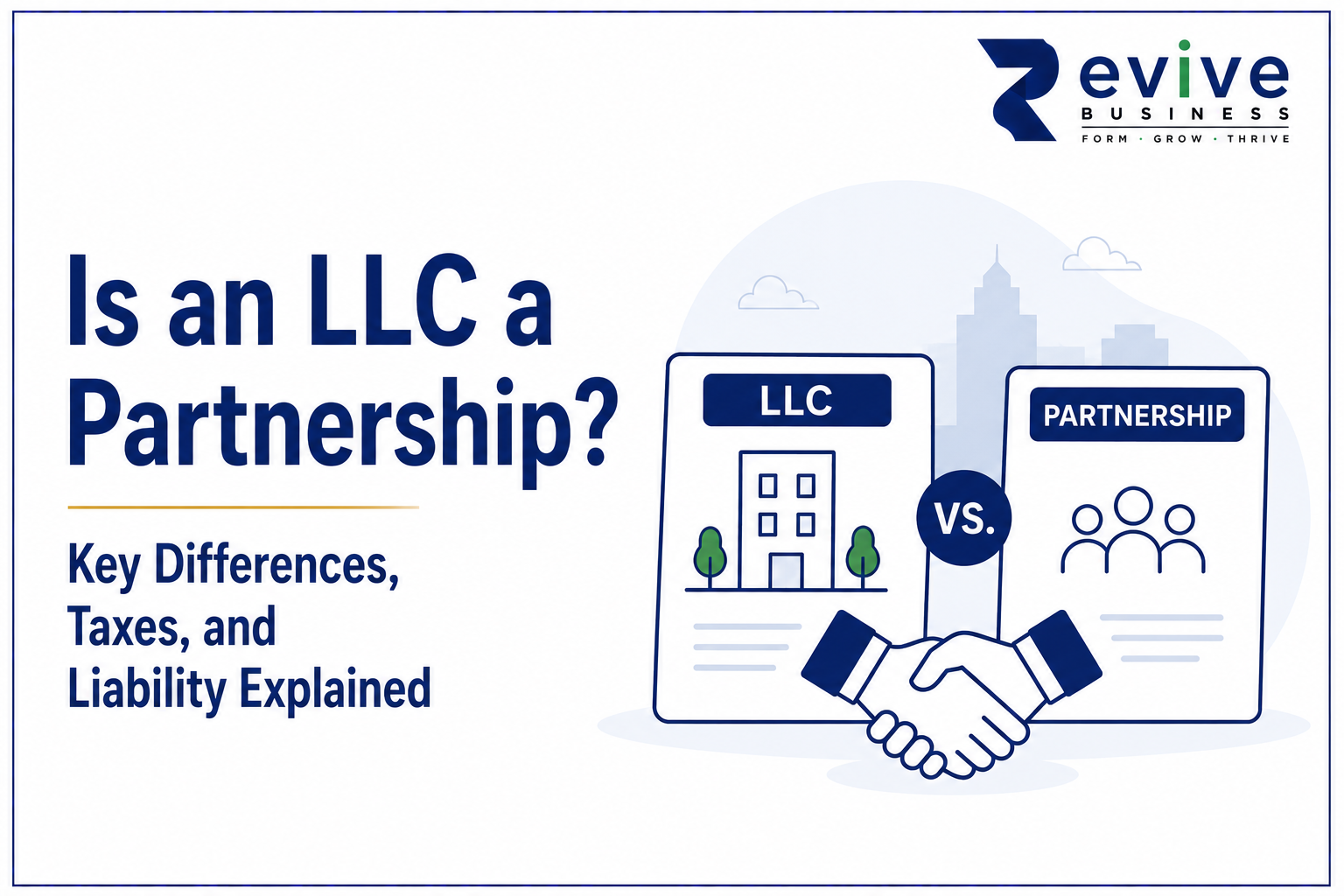
If you’re starting a business with one or more co-owners, you may be wondering whether an LLC is considered a partnership. While the two structures share some similarities, especially in how they’re taxed, they are not the same thing legally.
An LLC (Limited Liability Company) is a separate legal entity that helps protect owners from personal liability, while a partnership is generally a business arrangement between two or more individuals operating together without forming a corporation or LLC.
Understanding the difference matters because your choice of business structure affects taxes, personal liability, management rights, and long-term business flexibility.
In this guide, we’ll explain:
-
whether an LLC is a partnership,
-
how the IRS treats multi-member LLCs,
-
the key legal and tax differences,
-
and which structure may be better for your business.
What Is an LLC?
A Limited Liability Company (LLC) is a legal business structure created under state law, typically through business registration services or by filing the required formation documents directly with the state.
That means if the business is sued or cannot pay its debts, the owners’ personal assets, such as personal bank accounts, vehicles, or homes, are usually protected.
An LLC can have:
-
one owner (single-member LLC), or
-
multiple owners (multi-member LLC).
An LLC's owners are referred to as members rather than partners.
Small business owners favor LLCs because they combine:
-
liability protection,
-
flexible tax treatment,
-
simple management structures,
-
and fewer compliance requirements than corporations.
What is a Partnership?
A partnership is an arrangement between two or more individuals who agree to run a business together, but do not incorporate the business as a separate legal entity. There are some common types:
General Partnership (GP): The profits and losses are distributed between the partners on a pro rata basis. In case of a lawsuit, both partners are held personally liable (even for the other partner's acts).
Limited Partnership (LP): One or more general partners run the business; they are fully liable to the business. Limited partners are investors with less control and limited personal exposure.
Limited Liability Partnership (LLP): Used often in businesses such as law, accounting, etc. It provides some protection to partners against negligence by their partners.
The main difference? There is no separation of the general partner from the business in a general partnership. Your personal property could be in danger.
Key Difference Between LLC and Partnership
Here's where most of the confusion lives. Let's lay it out clearly:
|
Feature |
LLC |
Partnership |
|
Legal entity |
Yes, separate from its owners |
No (GP) / Partial (LP, LLP) |
|
Personal liability protection |
Yes, for all members |
No for general partners; yes for limited partners |
|
Formation requirement |
State filing required |
Can exist without any filing (GP) |
|
Federal tax default |
Pass-through (like a partnership) |
Pass-through always |
|
Can choose corporate tax treatment |
Yes (S-Corp or C-Corp election) |
No |
|
Management flexibility |
Member-managed or manager-managed |
Partners manage jointly (GP) |
The most obvious difference in practice: forming an LLC generally helps protect your personal assets from business liabilities. A general partnership does not: That one difference makes the vast majority of people opt for an LLC when they are looking to start a multi-owner business.
Why Do People Confuse LLCs and Partnerships?
The way the IRS taxes multi-member LLCs is a major source of misunderstanding.
By default, the IRS treats a multi-member LLC as a partnership for tax return filing. This means the LLC itself usually does not pay federal income taxes directly.
In most cases, the LLC files:
-
IRS Form 1065, and
-
Schedule K-1 forms for each member.
Because of this tax treatment, many people assume an LLC and a partnership are legally the same thing. However, they are still different business structures under state law.
An LLC provides liability protection for its members, while a general partnership typically does not.
Example: LLC vs General Partnership
Imagine Maya and Jordan start a graphic design business together and agree to split ownership equally.
They might not be required to submit official documentation to the state if they function as a general partnership. However, both owners can be held personally liable for business debts, lawsuits, or contractual disputes.
For example, if a client sues the business and wins a large judgment, Maya and Jordan’s personal assets could potentially be at risk.
If they instead form a multi-member LLC, the business becomes a separate legal entity. Assuming they properly maintain the LLC and keep business finances separate from personal finances, legal claims are generally limited to the assets owned by the LLC itself.
LLC vs Partnership: Which Structure Is Better?
For most small businesses with multiple owners, an LLC is usually the safer and more flexible option.
An LLC may be the better choice if you want to:
-
protect your personal assets,
-
separate business and personal liability,
-
improve business credibility,
-
or maintain flexible tax options.
A partnership may still make sense in certain situations, such as:
-
professional firms that operate as LLPs,
-
short-term business arrangements,
-
or investment structures using limited partnerships.
Ultimately, the right choice depends on your industry, risk exposure, tax goals, and long-term business plans.
Common Mistakes to Avoid
-
Operating as an informal partnership by accident: In many states, if two or more people carry on a business together for profit without any formal structure, they've automatically created a general partnership, complete with shared personal liability. This can happen even if you never intended it.
-
Skipping the Operating Agreement: Even if your state doesn't require it, an LLC Operating Agreement is essential. It defines ownership percentages, profit distribution, and what happens if a member wants to leave. Without one, you're often stuck with default state rules that may not reflect your actual intentions.
-
Mixing personal and business finances: This is how members lose their liability protection. Keep separate accounts from day one.
-
Forgetting about state-specific rules: LLC formation requirements, annual fees, and tax treatment vary by state. What works in Texas may be structured differently in California or New York.
Frequently Asked Questions
Is a multi-member LLC considered a partnership for tax purposes?
For tax purposes, the IRS considers a multi-member LLC as a partnership, and that means that the LLC files a Form 1065 and distributes income to its members on a Schedule K-1. But unlike a general partnership, the LLC may choose to be taxed as a corporation if it is more beneficial for the business.
Can an LLC have partners instead of members?
Actually, it is not partners, but members. However, in everyday speech, many people use the two terms interchangeably. If your business is an LLC, then you are a legal member of the LLC along with your co-owners.
What's the biggest real-world risk of choosing a general partnership over an LLC?
If your business partner makes a poor decision, such as signing an unfavorable contract, causing an accident, or incurring debt, you may be personally responsible for the consequences, as the manager has explained.
Do I need a lawyer to form an LLC?
Not necessarily. There are lots of professional business formation services that are professional that the business owners make use of to do the filing properly and efficiently. However, if you have a complicated situation (more than one owner, outside investors, or substantial assets), hiring a business lawyer is worthwhile.
If my LLC is taxed as a partnership, do I still need to file a partnership tax return?
Yes. An LLC with multiple members, taxed as a partnership, files IRS Form 1065 every year. The individual income is then reported by each member on his/her personal return. Though the entity is an LLC, this is a normal partnership tax return filing mandate.
Which structure is better: LLC or a partnership?
An LLC is a better option for most co-owned businesses. You enjoy the same pass-through tax treatment as a partnership and have personal liability protection, which a general partnership does not provide. The primary exception being some professional or investment arrangements that call for or favor certain partnership forms.
Final Thoughts
An LLC is not the same as a partnership, even though the two structures may share similar tax treatment.
The biggest difference is liability protection. An LLC creates a separate legal entity that generally protects owners from personal responsibility for business debts and lawsuits, while a general partnership does not offer the same protection.
For many small business owners, forming an LLC provides a balance of:
-
legal protection
-
tax flexibility
-
operational simplicity
-
and professional credibility
Before choosing a business structure, consider speaking with a qualified attorney or tax professional to determine which option best fits your business goals and risk profile.
Contrary to what many people might think, an LLC is not a partnership. It can be owned.
Looking to register your LLC the proper way?
From the start, Revive Business has assisted business owners in 20+ countries with the formation, registration, and compliance of their LLC without all of the confusion or costly errors. We take care of all your compliance needs, from formation to renewal and beyond.