Is Rental Income Taxable
Is rental income taxable? Yes, but key tax deductions can lower your bill. Learn reporting rules, Schedule E setup, and write-offs for property.
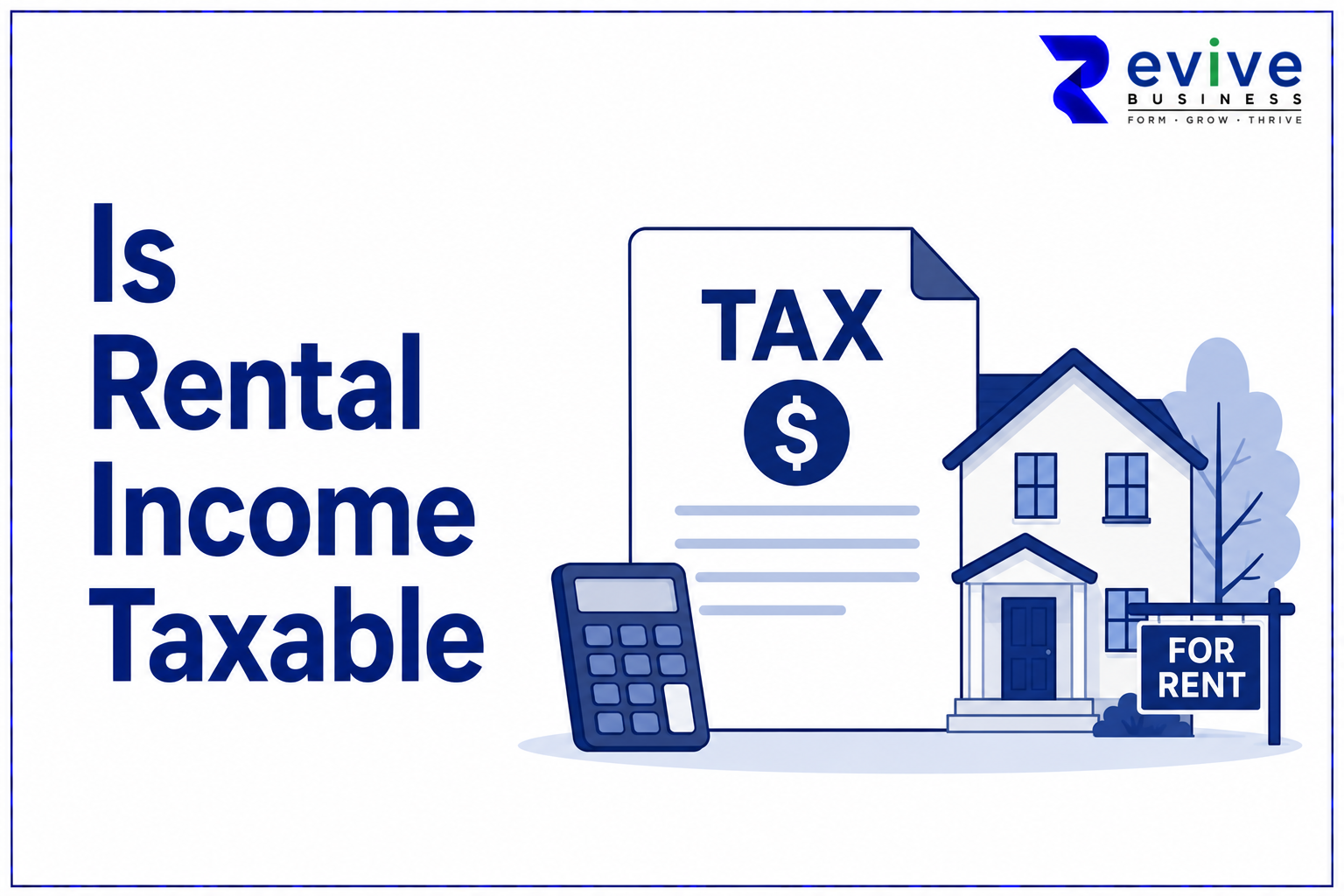
You receive rent each month. However, do you have to pay taxes on it? The quick answer is, of course, yes. Rental income is taxable in the United States (U.S.). The IRS considers it to be a normal source of income. Failure to do so may result in penalties. Knowing the rules helps to safeguard you and your investment.
Revive Business can assist landlords and small business owners in staying compliant. We help you file your taxes in an easy, precise, and stress-free way.
What is Considered Rental Income?
The IRS considers rental income to be any income that results from renting property. More than just monthly rent. Please do report the following:
-
Monthly rental income from tenants.
-
This is a prepaid advance rental.
-
This is a security deposit that is retained because of lease violations.
-
Rental charges for such services as parking and storage.
-
Property or services are accepted as rent instead of cash.
-
The rent or fees paid by tenants when they terminate their lease.
All of these are required on your income tax return. A frequent error is not reporting an item. It's also expensive.
Are There Any Rental Income Exceptions?
The one exception is this. You don't have to report the income if you rent your property for less than 15 days a year. This is the 14-day rule. This is a boon to many vacation homeowners.
If you also occupy the property personally for over 14 days or 10% of the days you are being rented out, then there are other rules that apply. Deductions become limited. It's important to have good records here.
Which Rental Expenses are Deduction Eligible?
The good news is that there are a few deductions that the IRS does allow. These lower the taxable rental income. Typical deductible items are:
-
Mortgage interest on the rental property
-
Property taxes paid in the year
-
The cost of insurance premiums related to the rental property.
-
The expenses of repairing and maintaining the equipment.
-
Property management fees
-
To attract new tenants through advertising.
-
Legal and professional fees
-
Devaluation of the property due to age.
-
Utilities paid by the landlord
Depreciation has a tremendous effect. A percentage of the value of your property can be deducted on an annual basis. Under IRS guidelines, the depreciation on a residential rental property is 27.5 years.
Our bookkeeping and accounting services help you track every deductible expense accurately. You never leave money on the table.
How to Report Rental Income?
The majority of landlords use Schedule E (Form 1040) to report rental income. This form is for use with supplemental income and loss. Here, you record your rental income and expenses that you have to claim as expenses.
You can be considered an active participant if you keep your rental property active. This means that rental losses up to $25,000 can be deducted from your adjusted gross income if it is below $100,000.
There are other rules for real estate professionals. Passive activity rules may not apply if you are involved in more than 50% of your activities in real estate. Talk to a tax consultant to determine your classification.
What About Self-Employment Tax?
Standard rental income is not subject to self-employment tax. One of the most important advantages of this is for the landlords. You are not required to pay the 15.3% self-employment tax, but rather regular income tax rates.
If you have a rental business, however, that involves a lot of services, such as cleaning the properties every day or providing meals, the IRS may consider it a business. If so, self-employment tax may be applicable. When booking a short-term rental via Airbnb, it could be a vacation rental.
State Taxes on Rental Income
That's only the federal taxes. The majority of states also levy tax on the rental income. Some states have unique income tax provisions, such as California, New York, and Illinois. In some states, such as Texas and Florida, there is no personal income tax.
There are also local occupancy taxes that might be triggered by STRs. These differ from city to city and county to county. To ensure compliance, it is necessary to understand the rules applicable to your area.
Our sales tax services keep you compliant with state and local tax requirements. We monitor changes so you never fall behind.
Common Mistakes Landlords Make
The IRS has a lot of problems with many landlords because of preventable mistakes. The most frequent errors are:
-
Not reporting all rental income received
-
Failure to report taxable deductions and claiming excess tax deductions
-
Mixing up repairs and improvements (tax implications differ)
-
Not keeping track of mileage when visiting the property
-
Not depreciating property correctly
-
Failure to make estimated tax payments on time
Revive Business offers expert tax return filing designed for landlords and investors. Our team understands rental property taxation inside and out.
How Revive Business Can Help
Rental tax management can be very stressful. Rules change. Deadlines shift. Deductions get missed. That's where we can help.
Revive Business is a professional landlord and investor's tax return filing. Your rental property is in our jurisdiction, and we know the rules!
We also provide:
-
Bookkeeping and accounting
-
Business formation support
-
Payroll tax management
-
Sales tax compliance
We have more than 20 years of experience, 50,000+ satisfied clients, and provide clarity and confidence. Your attention is on your real estate. We do the counting.
Frequently Asked Questions (FAQs)
Is rental income taxable if I only rent out one room?
Yes. Rental income includes income from renting one room. All earnings must be reported. A portion of household expenses, such as utilities and mortgage interest, can also be deducted.
Do I pay tax on rental income if my property runs at a loss?
No. When your expenses are more than your income from your rental, you have a rental loss. If your adjusted gross income is $100,000 or less, you may also be able to use that loss to claim a deduction for other income up to $25,000 per year.
Is Airbnb rental income taxable?
Yes. Airbnb and other income from short-term rentals are considered income. Rental properties where the tenant has rented the property for 15 days or more annually are required to be reported. If the amount you earn from the platform, such as Airbnb, is above a specific threshold, you might receive a Form 1099-K.
Can I deduct travel expenses to my rental property?
Yes. Any travel expenses to manage, maintain, or collect rents from your property are deductible. Record driving logs and receipts for all trips.
What is the difference between a repair and an improvement for tax purposes?
Repairs keep your property in the same state as it is today. They may be claimed in the same year's tax return. Value-adding or life-extending improvements. These need to be written off over a number of years. A repair is a fix made to something, such as repairing a broken window. Extensions to the bathroom facilities are improvements.
Are there quarterly estimated payments for rental income?
Yes, if you anticipate rental income taxes of $1,000 or greater, you must make quarterly estimated payments to the IRS. Penalties are applied if deadlines are not met. By sticking to a schedule, you will keep the cost of your tax bill manageable.
Final Thoughts
Yes, rental income is taxable. However, when you do it the right way, your tax burden remains manageable. Report all income. Claim every deduction. Remain in compliance with federal and state regulations.
Don't procrastinate organizing until the last minute in tax season. Begin keeping track of your income and expenses. The sooner you're ready, the better your results will be.
Ready to simplify your rental taxes? Schedule a free consultation with Revive Business today.