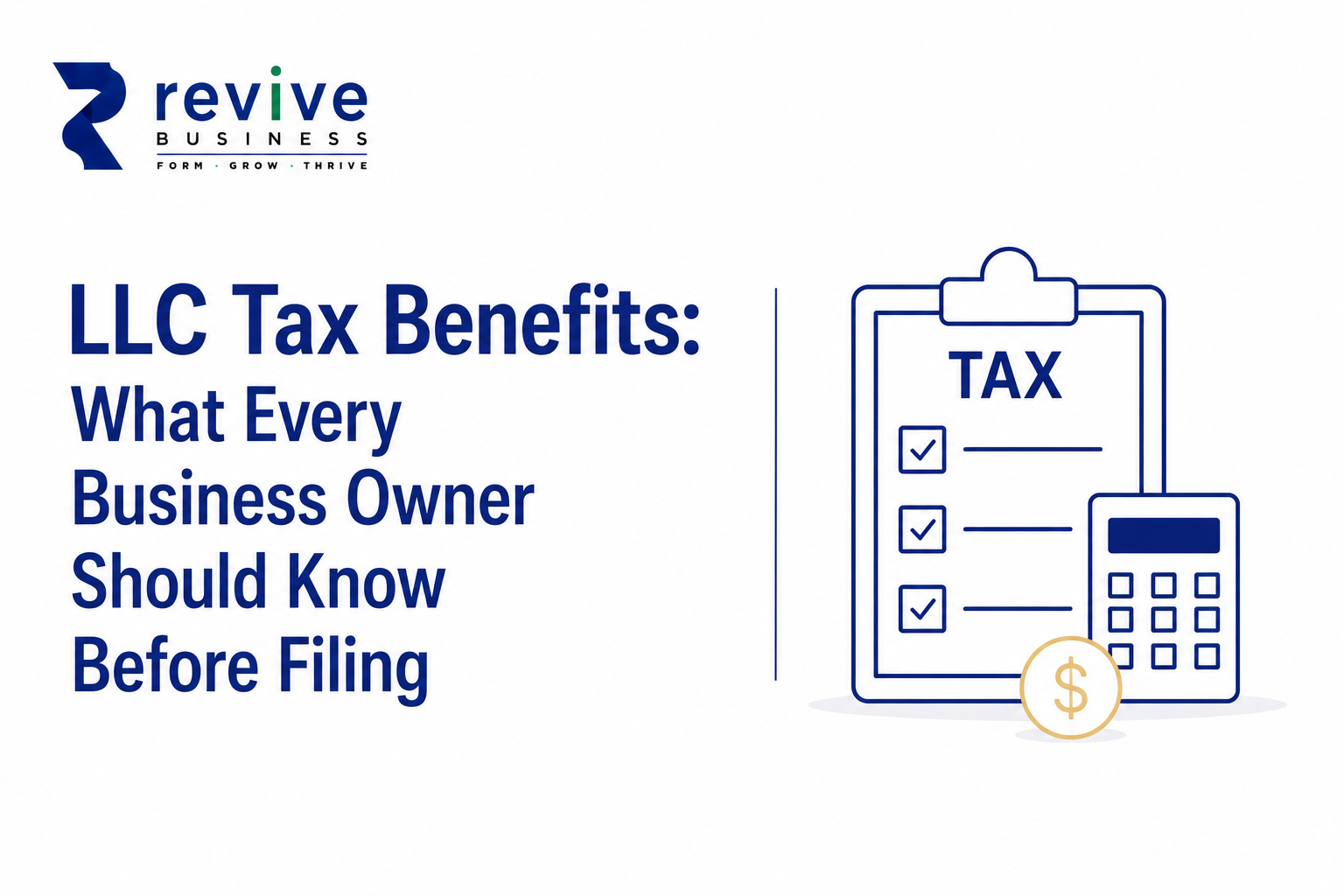
LLC Tax Benefits: What Every Business Owner Should Know Before Filing
Discover how LLC tax benefits work, including pass-through taxation, S-Corp election strategies, write-offs, and Section 199A QBI deductions.
Most people form an LLC for liability protection. Many don't realize it can also significantly affect how much tax they pay each year.
The reality is, an LLC is not a specific tax classification. Instead, the IRS allows an LLC to choose from several tax classifications. Knowing how that works could be the difference between sending more money to the IRS in April and paying less.
Here's how LLC tax benefits work and how business owners can take advantage of them.
1. Pass-Through Taxation: The Foundation of LLC Tax Benefits
By default, the IRS treats a single-member LLC as a disregarded entity and a multi-member LLC as a partnership for federal tax purposes. However, an LLC can elect to be taxed as an S corporation or a C corporation if doing so is beneficial.
Instead, profits and losses pass through to the owners' personal tax return. The most important benefit of a C-corporation structure is that you are taxed on the money once, and not twice.
Example: A freelance consultant working as an LLC makes $90,000 net profit. That income goes directly to her on her 1040 without paying corporate income tax at the entity level.
That's why many owners begin with this: It's easy, doesn't go through any layer of corporate taxes, and still maintains the liability protection an LLC is known for. Check out the official IRS explanation of pass-through entity taxation to see the whole story.
2. The S-Corp Election: Where Real Tax Savings Happen
One of the biggest potential tax advantages comes from electing S corporation taxation. LLC owners are subject to self-employment tax on the net profit, not a salary, unless they elect S corporation tax treatment. That adds up fast.
If your LLC is making enough money, you may choose to tax your business as an S Corporation, which can lessen that burden. Under this election:
-
You are paid a "reasonable salary" by payroll
-
Only that salary is liable for employment tax.
Distributions of remaining profits are not subject to the extra self-employment tax.
Example: An LLC nets $150,000. If the owner pays themselves a reasonable salary of $70,000 and distributes the remaining $80,000 as shareholder distributions, only the salary is generally subject to payroll taxes.
That's where the right payroll tax services company is necessary. The IRS takes “reasonable salary” seriously and is quick to audit taxes if it's not handled properly. A qualified provider aids in determining defensible compensation and also assists with the continuing filings appropriately.
3. Deductible Business Expenses
LLCs may deduct normal and necessary business expenses directly from their income before profit is determined, thus reducing their taxable income. Several deductions are often overlooked, such as:
-
Home office expenses (if eligible)
-
Business travel and vehicle expenses
-
Health insurance premiums for self-employed owners
-
Retirement plan contributions (SEP-IRA, Solo 401(k))
-
Professional services such as legal, accounting, and formation fees
Documentation is the key. It is just as important to maintain clean records throughout the year, and vague or unsupported deductions attract IRS scrutiny; they are one of the quickest to be noticed.
4. State-Level Considerations Matter Too
Tax incentives are not just a federal issue. The LLC franchise tax, annual filing fees, and filing requirements vary significantly by state, and some states are quite LLC-friendly compared to others.
This is one reason why keeping a registered agent service in your formation state is not only a legal formality. It does this to make sure that you don't miss any tax notices or any state filings because many state tax notices and filing deadlines are time-sensitive.
5. Getting the Structure Right From Day One
Many tax deductions and credits go back to the LLC's original formation. It can cost thousands of dollars over time to select the wrong state, not understand the difference between members and managers of the LLC, and not make the election in time.
Ensuring your business is structured to take advantage of every available tax benefit is much easier if you have established the company with proven LLC formation services from the beginning.
Frequently Asked Questions
Does forming an LLC automatically reduce my taxes?
Not automatically. An LLC is a way to give you the flexibility you want to choose the optimal tax structure; however, actual savings would depend on your income level, elections you make, and your expense tracking.
When should I consider an S-corp election for my LLC?
Many tax professionals recommend evaluating an S-corp election once profits consistently exceed a certain level, but the right threshold depends on your situation.
Can a single-member LLC get the same tax benefits as a multi-member one?
Yes. Single-member LLCs continue to be pass-through taxed and may also choose to be taxed as an S-corp if it is financially advantageous.
Do I still need a registered agent after formation?
Yes, most states require an ongoing registered agent, not only at filing. It is linked to good standing and receiving legal and tax correspondence.
Make Your LLC Work Harder for You
LLC tax benefits don't just happen; they are the result of proactive decisions taken in the early stages and consistently followed. The right setup can produce meaningful long-term tax savings. From formation, payroll, and all the way through compliance.
When it's time to set up your LLC for true tax efficiency, our team can help you with formation, registered agent services, and payroll tax management, all in one place. Speak with our team to determine which tax strategy best fits your business.