PLLC vs LLC: What's the Difference and Which One Do You Need?
Deciding between a PLLC and an LLC? Learn the key differences in liability, state licensing rules, and tax setups for licensed professionals.
When you're looking for a business or professional practice, you may have seen the terms LLC and PLLC in your research, not knowing the difference between them and wondering if it really makes a difference in your business scenario.
It does. In the event that you are involved in a licensed occupation, the entity type you select can be a headache when it comes to compliance in the future. If you're looking to proceed with your plans, this guide explains the difference between PLLC and LLC in a clear way.
What Is an LLC?
A Limited Liability Company (LLC) is one of the most popular business structures in the United States, and for good reason. Provides personal liability protection, flexible tax treatment, and relatively simple management requirements to the business owner.
Most importantly, an LLC can be founded by virtually any kind of business. However, for any business, from an e-commerce business to a marketing agency, consulting firm, or restaurant, the LLC is generally available.
Real-world example: An individual freelance graphic designer can set up his or her business in Texas as an LLC, limit his or her personal liability for claims by clients, and decide to be taxed either as a sole proprietor or opt for S corporation status. Does not require a professional license to create the entity.
What Is a PLLC?
A Professional Limited Liability Company (PLLC) is a special type of LLC, which is only effective for licensed professionals. Consider doctors, lawyers, dentists, CPAs, architects, and engineers.
PLLCs were created because state licensing boards wanted to retain control over the regulated professions even when they were set up as a business. A PLLC affords professionals the benefits of a limited liability company, while also subjecting their practice to professional licensing requirements.
Real-world example: Illinois is a prime example in which a psychiatrist wishes to establish a private practice but cannot just create a simple LLC in most states. She would have to create a PLLC, and each member of the PLLC would have to have a comparable professional license.
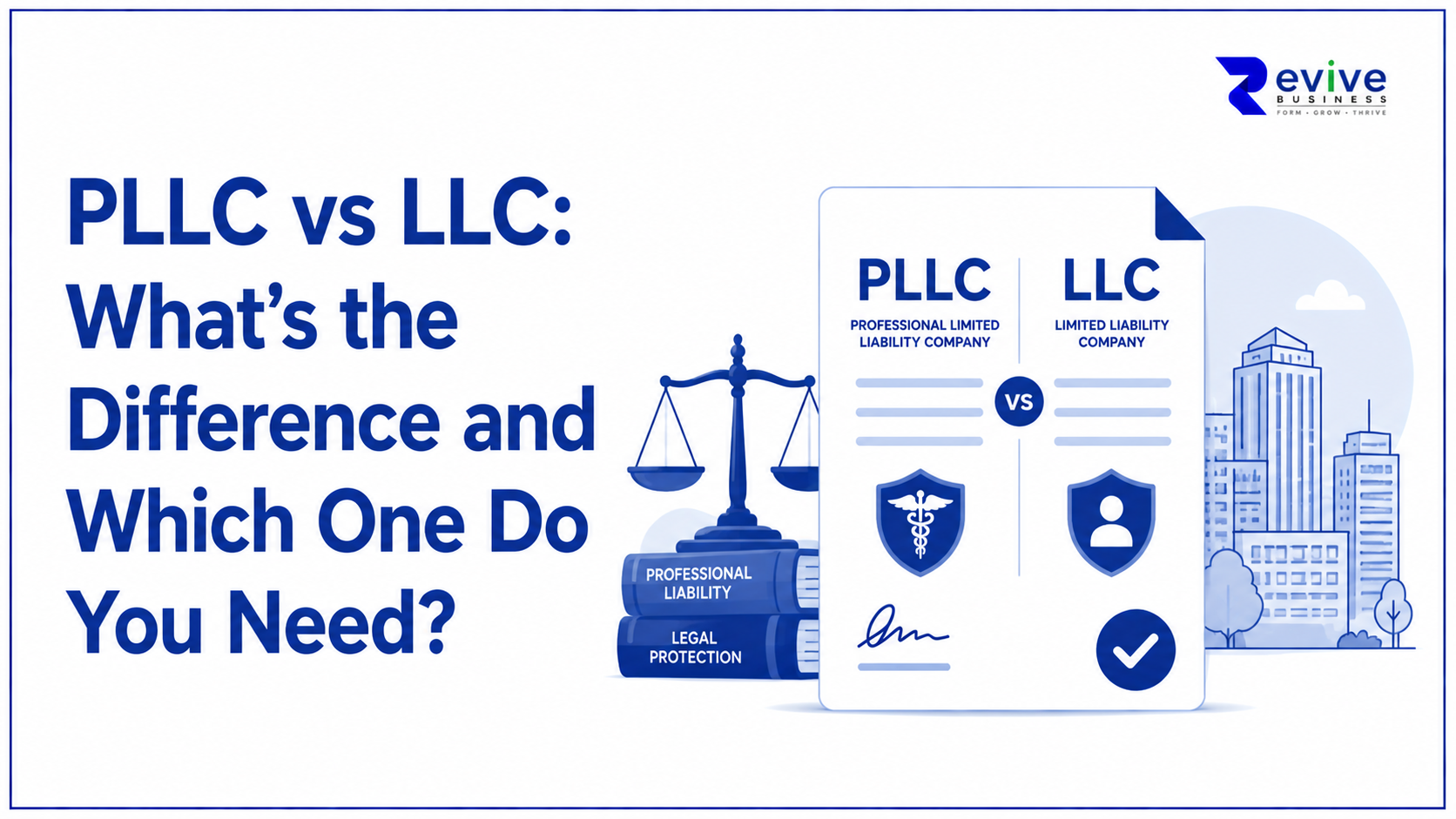
PLLC vs LLC: Key Differences
Here's the comparison table covering all 8 key difference categories.
|
Category |
Limited Liability Company |
Professional LLC |
|
Who can form it |
Any individual or business, no credentials required |
Licensed professionals only (doctors, attorneys, CPAs, architects, etc.) |
|
Liability protection |
Protects personal assets from most business debts and lawsuits |
Same protection, but does not cover your own professional malpractice, only a co-owner's |
|
Ownership rules |
Open; individuals, corporations, other LLCs, and even foreign nationals can be members |
Restricted; all members must hold the same professional license as the practice |
|
Licensing requirement |
None; formation requires only standard state documents and fees |
State verifies active professional license(s) before approving the entity |
|
State Availability |
Available in all 50 states |
Not recognized in every state; some states use PC (Professional Corporation) instead |
|
Tax Treatment |
Pass-through by default; can elect S-corp or C-corp taxation |
Identical to LLC; pass-through by default, same election options available |
|
Name requirements |
Must include "LLC" or "Limited Liability Company." |
Must include "PLLC" or "Professional Limited Liability Company" in most states |
|
Best for |
Freelancers, startups, retailers, consultants, and general businesses |
Medical practices, law firms, dental offices, therapy practices, and accounting firms |
Which One Should You Choose?
It is typically easy to know the answer once you see it.
Select a standard LLC if:
-
Are not a qualified professional in the state where you practice.
-
You are in a general industry (Retail, Consulting, Tech, Trades, etc.)
-
You need the most flexibility in ownership.
-
Your state doesn't require a PLLC for your profession
Choose a PLLC if:
-
You're a licensed professional: doctor, lawyer, CPA, dentist, therapist, engineer, architect, or another licensed profession.
-
A PLLC (or similar entity) is required by your state for licensed professionals.
-
You would like some protection from a co-owner's professional negligence.
Two quick comparisons:
A freelance copywriter may be a "professional service provider," but the licensed speech therapist must consider a PLLC. The copywriter can set up a regular LLC without any trouble whatsoever.
A practitioner who is starting practice on their own should also check state requirements. Attorneys normally form PLLCs in New York. They would probably go with a Professional Law Corporation in California. The structure has an impact, and state rules make the decision.
How the Formation Process Works
The basic steps involved in creating an LLC or PLLC are similar:
-
Making a selection of which form you wish to use.
-
Choose and check your business name (PLLC will need designations such as PLLC or Professional LLC).
-
Designate a Registered Agent
-
Draft Articles of Organization (or PLLC Articles of Organization)
-
Create an Operating Agreement
-
Get necessary licenses and/or EINs
The state will usually require a second verification with PLLCs, including verification of your professional credentials, before the filing is approved.
Working with professional LLC formation services can make this process significantly smoother, and can help you through this process more easily, particularly if you are dealing with rules for the profession or filing in an unfamiliar state. The paperwork is done properly during a formation service, so it won't be a hassle to correct mistakes later.
The Role of a Registered Agent in Both Structures
No matter if you create an LLC or PLLC, you will require a registered agent in your formation state.
A registered agent is a registered individual or company that receives legal and government mail for your company.
This is a particularly critical role for licensed professionals. Failure to receive a legal notice due to a previous address, or due to the fact that no one was there to receive it, can lead to compliance problems or a default judgment. This is why it's important to have a dedicated registered agent for professional practices to maintain that communication line and to avoid any important details falling through the cracks.
Common Mistakes to Avoid
The following are the common mistakes to avoid.
-
Forming the wrong entity type. If your state requires a PLLC, and you are a licensed professional, a standard LLC may be a problem for licensing and invalidate your entity status. Don't assume; verify.
-
Ignoring state-specific rules. The difference between an LLC and a PLLC is not consistent throughout the country. Requirements in Arizona can be very different from those in Georgia. Please always do your own research on the state you are targeting.
-
DIY formation errors. One mistake that is common and costly is completing formation papers in haste or copying and pasting documents from the internet for a profession that you do not understand. Common formation errors may not become apparent until you are up and running, and correcting errors after a formation has been completed is more costly than catching them in the beginning.
Frequently Asked Questions
Is a PLLC better than an LLC?
Not necessarily; it depends on your profession and state. Many professionals who are licensed require a PLLC (not an option). Standard LLC structures are generally most suitable for general businesses, because they offer their members the most flexibility.
Can any business form a PLLC?
Only licensed individuals in qualified disciplines may form No. PLLCs. Different states have different professions that qualify. A PLLC is not available to those who are not in a licensed profession.
Do PLLCs pay different taxes?
Yes, PLLCs are generally taxed the same as standard LLCs. Both are typically treated as pass-through entities, meaning business income passes through to the owners’ personal tax returns. Both can also elect to be taxed as an S corporation or a C corporation.
What professions typically require a PLLC?
Some of these will vary from state to state, but typical professions that are included are: Physicians, Surgeons, Dentists, Attorneys, CPAs, Licensed Therapists, Psychologists, Architects, and Engineers. Chiropractors, optometrists, and pharmacists are also included in some states.
Can a non-licensed person be a member of a PLLC?
In most States, no, PLLC ownership is typically limited to people who are licensed to practice the same profession as the PLLC. The typical non-licensed investor will not be able to own an interest in a PLLC.
What happens if I form the wrong entity type?
The wrong structure may lead to a fine, loss of limited liability, or problems with your professional licensing board in some states. It's best to get the structure right before you start operating.
Ready to Form Your LLC or PLLC?
There's no formula for choosing between a PLLC and an LLC, but there are nuances to consider for your profession and state.
At Revive Business, professionals and entrepreneurs can navigate the process of entity formation with clarity and confidence. If you are a licensed practitioner starting your practice or a business owner nearing the time to make your business official, we can help ensure that your business is formed correctly from the beginning.
Visit Revive Business to check what options are at your disposal and make the first move towards a well-structured business.