Progressive Tax vs Flat Tax: Which Is Better?
Progressive tax vs flat tax: understand how each system works, their impacts on business income, and strategies to optimize your tax bracket.
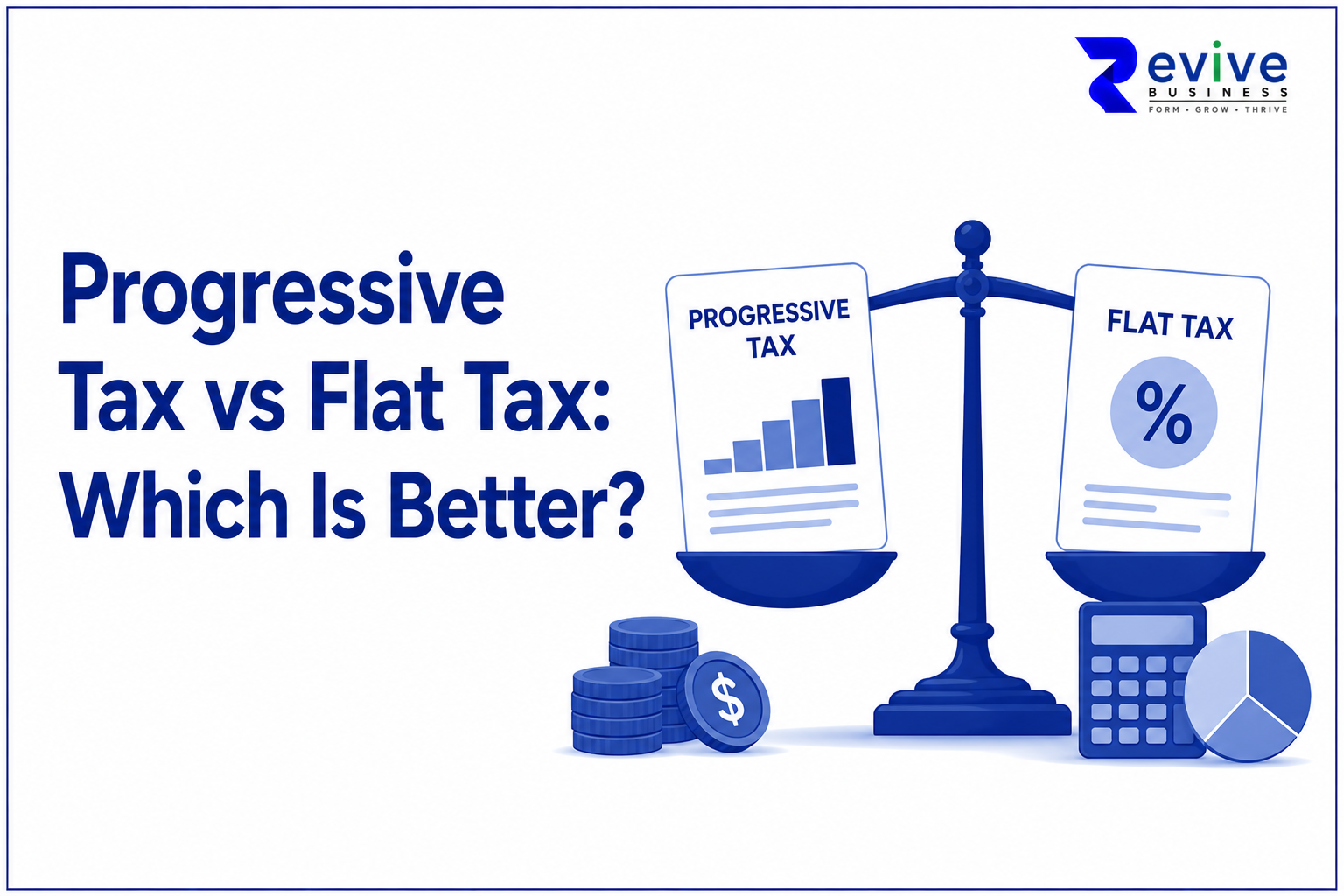
Understanding the difference between a flat tax and a progressive tax can help you make better financial and business decisions. A flat tax applies the same tax rate to everyone regardless of income, while a progressive tax increases tax rates as income rises.
Whether you are an employee, freelancer, investor, or business owner, the tax system affects budgeting, profits, investment decisions, and long-term planning. In this guide, we’ll explain how flat tax works and how progressive tax works, compare their pros and cons, and show how each system impacts real-life finances.
What Is a Flat Tax System?
A flat tax system applies the same tax rate to all taxable income, regardless of how much a person earns. Everyone pays an identical percentage, which makes the system simple and predictable.
For example, if a country uses a 10% flat tax:
-
A person earning $25,000 pays $2,500 in taxes
-
A person earning $250,000 pays $25,000 in taxes
Even though higher earners pay more in total dollars, the tax rate remains the same for everyone.
Key characteristics of a flat tax system:
-
One fixed tax rate for all income levels
-
Simpler tax calculations and filing
-
More predictable tax outcomes
-
Lower administrative complexity
Supporters of flat taxes often argue that they encourage efficiency and simplify compliance for businesses and individuals.
What Is a Progressive Tax System?
A progressive tax system increases tax rates as income rises. Instead of everyone paying the same percentage, higher-income earners pay higher rates on portions of their income.
This follows the ability-to-pay principle, where higher earners pay a larger percentage in taxes.
A simplified example may look like this:
-
Lower income bracket: 10%
-
Middle income bracket: 20%
-
Higher income bracket: 30%+
Most developed economies, including the United States, use a progressive income tax structure.
How Progressive Tax Works (Simple Example)
One of the biggest misunderstandings about progressive taxes is that not all of your income is taxed at the highest rate.
Instead, income is taxed in portions called tax brackets. Each bracket has its own tax rate.
Example:
Suppose tax brackets are:
-
10% on the first $20,000
-
20% on income between $20,001 and $50,000
-
30% on income above $50,000
If someone earns $70,000:
-
First $20,000 → taxed at 10%
-
Next $30,000 → taxed at 20%
-
Remaining $20,000 → taxed at 30%
This approach is known as marginal taxation, and it helps explain why moving into a higher tax bracket does not mean all income gets taxed at the highest rate
Flat Tax vs Progressive Tax: Core Differences
Let's have a very simple breakdown of flat tax vs progressive tax:
|
Factor |
Flat Tax |
Progressive Tax |
Who Benefits Most |
|
Tax Rate |
Same rate for everyone |
Increases with income |
Flat tax benefits high-income earners more; progressive tax benefits lower- and middle-income earners more |
|
Complexity Model |
Simpler to calculate |
More complex |
Flat tax benefits taxpayers and businesses due to simplicity; progressive tax benefits systems focused on detailed redistribution |
|
Fairness Model |
Equal percentage paid |
Ability-to-pay principle |
Flat tax benefits high earners and simplicity-focused systems; progressive tax benefits lower-income groups |
|
Compliance |
Less paperwork |
More reporting requirements |
Flat tax benefits individuals and small businesses; progressive tax benefits governments needing detailed income tracking |
|
Financial Predictability |
Higher |
Lower due to brackets and deductions |
Flat tax benefits stable income planning; progressive tax benefits social welfare funding flexibility |
Why Tax Systems Matter in Real Life
Tax systems influence far more than annual tax bills. They can affect business planning, budgeting, investing, and long-term financial decisions.
For example:
-
A freelancer may prefer predictable taxes for budgeting
-
A high-income consultant may pay higher marginal tax rates in a progressive system
-
A startup founder may evaluate tax structures when deciding where to register a business or reinvest profits
Two people with the same income may also pay different effective tax rates because of deductions, tax credits, and local tax rules.
Business Planning and Tax Strategy
Taxation is an important consideration that must be taken into account as a part of starting a business, not as an afterthought.
Many entrepreneurs evaluate jurisdictions based on tax structure, especially when considering whether to form an LLC in a flat-tax state. The primary attraction is typically simplicity; fewer brackets, fewer surprises, and simpler compliance planning.
But it's not all about tax rates. Also consider the following:
-
State compliance requirements
-
Annual filing obligations
-
Local regulations and Licensing
-
Long-term business scalability
Why Professional Tax Help Matters?
Tax planning is much simpler when you have professional assistance, regardless of whether you're in a flat or progressive tax system.
The professional tax return services usually assist with:
-
Correctly filing and complying with the law
-
Maximizing legal deductions
-
Planning for the entire year
Small reporting errors in progressive systems can lead to undue tax liabilities or compliance issues.
Which Tax System Is Better?
There is no universally “better” tax system because the answer depends on priorities.
A flat tax system may appeal to people who value:
-
Simplicity
-
Predictable tax planning
-
Easier compliance
A progressive tax system may appeal to people who value:
-
Income-based fairness
-
Redistribution of tax burden
-
Greater contribution from higher earners
For individuals and business owners, the best approach is understanding how the tax system affects income, deductions, investments, and long-term planning.
Common Misunderstandings
There are a couple of misconceptions that can confuse taxpayers:
-
A progressive tax is a tax on all income at the highest rate.
False; only income in each bracket is taxed at that rate.
-
“Flat tax" is defined by the absence of any deductions.
Not always; there are still some systems that permit standard deductions.
-
No matter what, a lower tax rate equals lower taxes.
Not always, though it goes without saying, taxable income and structure are at least as important.
A Broader View: Global Tax Systems
Taxation policies vary among countries based on economic objectives. Tax systems have been the subject of study by international bodies such as the OECD on a regular basis, including an OECD study on the effects of tax systems on growth, fairness, and investment trends.
OECD Tax Policy Overview: This illustrates that tax isn't only a local problem; it's part of a global economic approach.
Final Thoughts
The debate around flat tax vs progressive tax ultimately comes down to two competing priorities: simplicity and fairness.
A flat tax keeps calculations predictable by applying one rate to everyone, while a progressive tax adjusts rates as income increases. Neither system is universally better; each reflects different economic goals and policy priorities.
Understanding how taxes work can help individuals and business owners make smarter financial decisions, avoid surprises, and plan more effectively for the future.