Sole Proprietorship Disadvantages Every Small Business Owner Should Know Before Starting
Starting a sole proprietorship? Discover the major hidden risks, from unlimited personal liability to limited tax options; before you launch.
Starting a business is exciting. But in case you go solo, a sole proprietorship appears as the simplest solution, without all the hassle, registration, and other complexities.
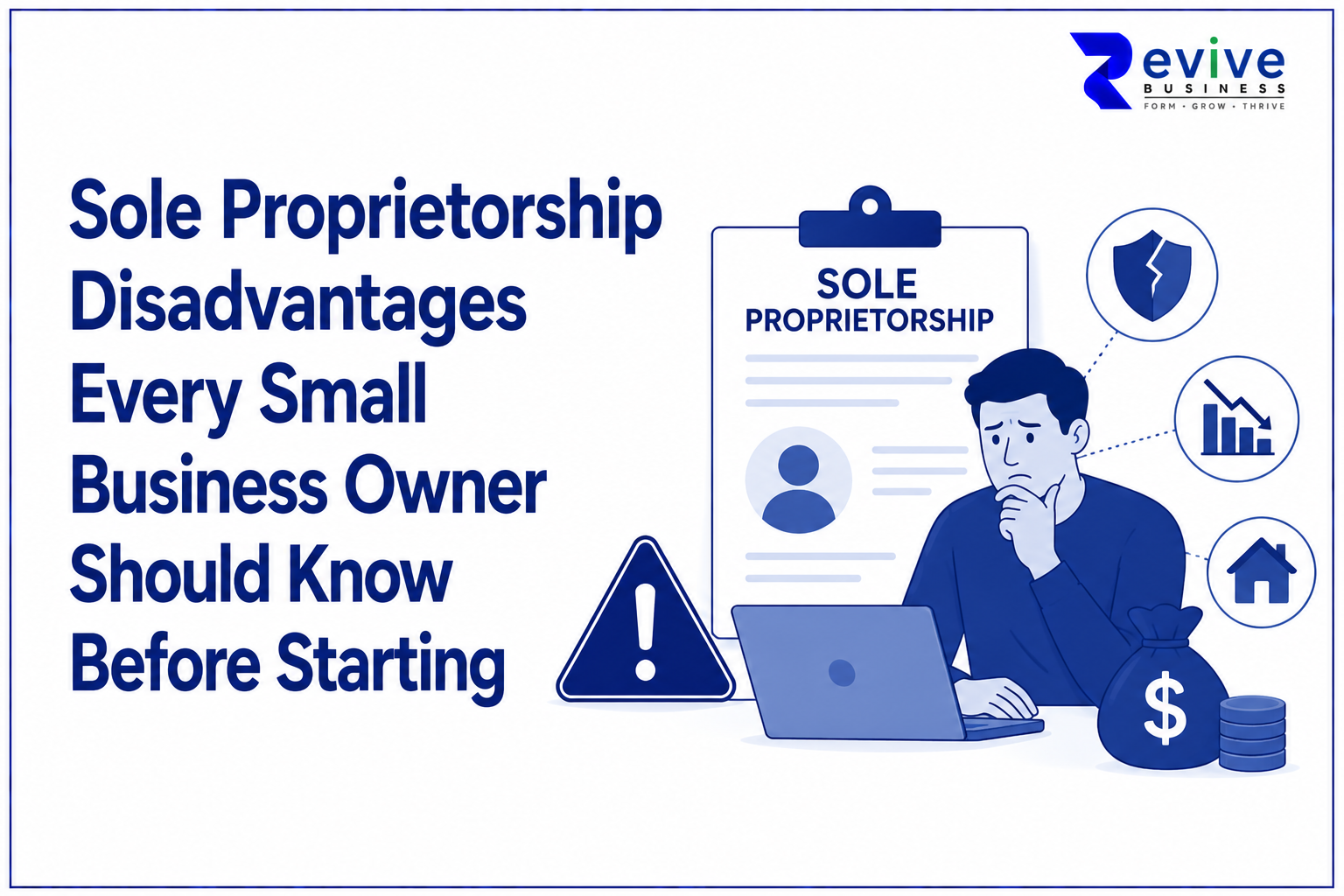
However, this is what nobody tells you straight from the start. Some very serious sole proprietorship disadvantages may come at the cost of losing your personal belongings, savings, and sometimes, everything you have.
Here, you will find a list of key drawbacks of owning a sole proprietorship, discussed in practical examples and situations rather than just theoretical aspects. These may come in handy when making decisions about forming a business entity.
What Is a Sole Proprietorship? (A Quick Baseline)
Sole proprietorship is the simplest type of business organization. In a sole proprietorship, there is no distinction between the business owner and his/her business. This means that you report business income on your personal tax forms, sign agreements using your personal name, and are fully responsible for all actions and decisions made by your business.
Based on the U.S. Small Business Administration, a sole proprietorship is the most common type of business entity in the U.S., due to no necessity to register such organizations in most states.
But common doesn't mean optimal. Here's why.
Unlimited Personal Liability: Your Largest Risk
This is one of the largest and riskiest pitfalls you will face.
With a sole proprietorship business type, there is no wall that separates your personal property from that of your business. This means that any lawsuits, losses, and disputes from your business operations could easily extend into personal matters and affect your house, savings, and vehicle.
Example: One day, a freelance web designer operating as a sole proprietor designs a website for his customer. The customer is convinced that the website cost him $50,000 in sales and decides to sue. Since the designer is a sole proprietor, he has no legal protection against any lawsuit, and everything he has is at stake.
This situation may seem fictitious, but it happens every single year. Luckily, all of this is completely avoidable with proper structuring.
If protecting your personal property is a major concern (which it should be), form an LLC to protect your assets rather than being a sole proprietorship.
The Self-Employment Tax Is More Expensive Than Expected
If you work for an employer, payroll taxes are shared. You pay half, and they cover the other half. As a sole proprietor, however, you are responsible for the full self-employment tax rate. This includes both the employer and the employee tax.
At 15.3%, this tax rate applies to net profit from your work. For an individual making $80,000 in net profits, this means paying over $12,240 in self-employment tax before calculating income tax.
Failing to understand the full weight of your liability here leaves many sole proprietors unprepared come tax time.
This is another instance where planning can make all the difference. Tax preparation for small business and planning involves more than just meeting deadlines. It may involve income structuring, timing, and even reorganizationinto an S-corporation, among other methods, to pay less tax than you otherwise would.
As noted by the IRS Self-Employed Tax Center, this is how you calculate your quarterly tax payments, but it does not tell you how to minimize their impact.
Harder to Raise Capital and Get Business Credit
Financial institutions and potential investors analyze the business entity. The structure of a sole proprietorship business indicates informality, and informality is seen as risky by banks.
A sole proprietor applying for a business loan usually has to put up personal collateral or make use of their personal credit rating. There are no shares to offer; partners can only be brought in through a complete restructuring process, and very few investors would even consider investing in an unincorporated company.
This stands in contrast to businesses such as LLCs and corporations that can access business loans and maintain a credit history independent of the owner's financial standing.
The practical impact: The consequence of this challenge is that when the time comes to scale up operations and obtain funding for employees, leasing premises, and purchasing machinery, sole proprietors will find themselves with fewer options than other types of businesses.
Individual vs. Sole Proprietorship: Importance of Knowing the Difference
One of the most frequently asked questions among starters concerns the differences between an individual vs sole proprietorship. The difference might seem trivial, yet important enough to take into account.
Individuals are ordinary people. A sole proprietor is a person who runs a business alone and is its only legal representative. Legally, the owner and the business are treated as the same entity.
The difference becomes apparent with:
-
Signing contracts in your personal capacity
-
Applying for licenses in your personal name
-
In the case that you pass away or are incapable of running the business anymore, your company will automatically terminate its activities.
-
There will be no continuity; you won’t be able to pass on the ownership rights to someone else, like you could in an LLC.
For those who offer their services once in a while, the merging of identities might not bother them. However, for those who want to do something bigger, such a lack of distinction becomes complicated to handle.
Lack of Business Continuity
Your sole proprietorship exists because you do. Your retirement, your sickness, and your death end your business, and it goes down with you.
This is a big problem when it comes to future selling or passing down the company to another person, since buyers are interested in acquiring a business entity rather than buying from individuals and contracts. In this scenario, your company does not really mean anything.
A sole proprietorship lacks longevity since it will die with you, unlike an LLC or corporation, which is its own legal entity that can be sold, inherited, and even dissolved.
Lack of Credibility in Some Markets
One important disadvantage that is usually left out but deserves attention is the issue of credibility.
Some clients, especially large enterprises, require certain documents for contracting that a sole proprietorship cannot provide. This means some markets are not open to you.
Gaps in Business Insurance
Sole proprietorships frequently fail to recognize their vulnerability regarding insurance matters. Each one of general liability, errors and omissions insurance (professional liability), and commercial property insurance functions differently when there is no LLC in place.
Some business insurance will not cover losses without an LLC in place. There may even be higher premiums associated with the personal liability that comes with this arrangement. The individual and his/her business would both be insured entities.
When a Sole Proprietorship Does Make Sense
To be honest, there are a few instances where a sole proprietorship makes sense. For instance:
-
It's a way to test the waters before moving into any business venture
-
It's cheap because you earn less money and have little liability exposure
-
It operates in an environment with little legal liability
However, in each of these instances, most business owners grow out of a sole proprietorship structure rather quickly. The bottom line is that it's more expensive to change a sole proprietorship structure to something better at a later stage compared to starting with the right structure from the outset.
The Smart Alternative Approach
Here is what you should do when forming your business:
-
Set up an LLC that protects your personal assets from lawsuits against your business; it's inexpensive and simple
-
Prepare your taxes as a small business to get the best tax advantages from the beginning
-
Consult with a professional to know which business structure suits your goals
The IRS also provides a helpful business structure comparison tool that outlines tax implications by entity type.
Frequently Asked Questions
Can I change from a sole proprietorship to an LLC?
Yes, you certainly can. It's a relatively simple process that entails registration of the LLC and transfer of assets, contracts, licensing, and bank accounts. Changing isn't too difficult – it's easier to form a sole proprietorship as an LLC at the start.
Does a sole proprietorship negatively affect taxation?
Not necessarily, but a sole proprietorship is often less advantageous than other options. In a sole proprietorship, you'll have to pay self-employment tax for all profits made. An LLC/S-corporation offers more options here.
What is the difference between a sole proprietorship and a DBA?
A DBA only represents a fictitious business name without making any changes to your business's legal nature. If your business is a sole proprietorship, even after registering a DBA, you will be personally responsible for all business activities.
Do I need insurance if I'm a sole proprietor?
Yes, because, despite the lack of legal protection, insurance may cover some risks. In most cases, general liability insurance will suffice, especially if your business provides services.
Can a sole proprietor hire employees?
Sure, there's no reason why a sole proprietor cannot employ others. However, it means the proprietor becomes responsible for managing employees and is personally liable for their wages, taxes, and any legal obligations arising from their work.
Final Thoughts
While these are indeed some of the disadvantages associated with the sole proprietorship, these are not intended to prevent you from pursuing the entrepreneurial spirit but rather to give you better information before you make the decision.
Remember, simple doesn’t always mean safer, and what you decide on day one is going to have far-reaching consequences throughout your journey: taxes, exposure to liability, expansion capabilities, and even future exits from your venture.
If you’re willing to create something lasting, then do it right from the beginning.
-
At Revive Business, we provide entrepreneurs and small business owners with the necessary information needed when making choices on how to set up their businesses, plan their taxes, and manage their financial futures.