What Is a Letter of Good Standing & Why You Need It
Learn what a Letter of Good Standing is, why your LLC or business needs one, how to request it from the Secretary of State, and key compliance rules.
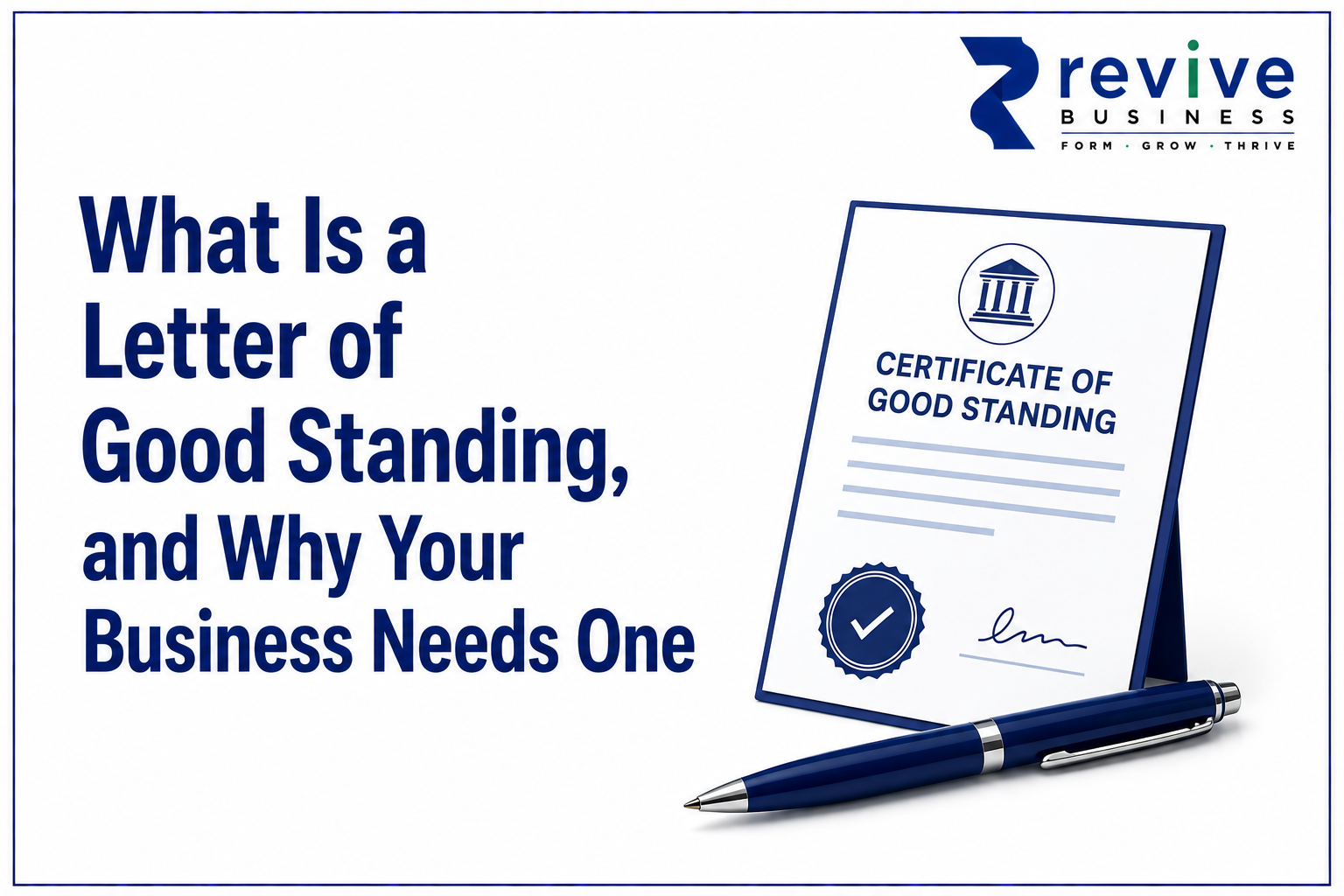
One of the business documents that a business owner never really considers until it is needed is a certificate of good standing.
When you are just about to open a business bank account, apply for financing, enter into a commercial lease, or move to a new state, you find that some lender, attorney, or government entity requires proof that your company is legally compliant.
Without current records, that request may cause delays in deals, financing, or registrations.
So let's take a look at what a certificate of good standing is, when it is needed, and how to avoid some common compliance pitfalls that may land you in trouble.
What is a Letter of Good Standing?
A certificate of good standing is one of the most important business compliance documents, yet many business owners don’t think about it until a bank, lender, or state agency requests it.
It can also be referred to as:
-
Certificate of Status
-
Certificate of Existence
-
Letter of Good Standing
Different states use different names for this document, including Certificate of Status, Certificate of Existence, or Letter of Good Standing. The document verifies that your business:
-
Has a valid legal structure and is actively operating
-
Is formed and is active as a legal entity
-
Has submitted the required annual reports
-
Has paid the required state fees or franchise taxes
-
Maintains accurate business records
-
Has not been administratively dissolved
Simply put, it signifies that your company is legitimate in that state.
Why is a certificate of good standing important?
A certificate of good standing demonstrates that your business is up to date and in good standing.
It is also frequently requested by third parties before making any financial or legal arrangements, as they want to be sure that your company is legitimate and active.
Even a well-established business can be held up without it.
A small consulting firm that changes its business location, for instance, might find that its annual report wasn’t filed with the state. It could be that the business is still operational, but the state can record the business as “not in good standing” until the filing situation is corrected.
That can cause funding to be delayed for weeks.
When You'll Actually Need One
There are several reasons why you might need a Certificate of Good Standing.
This document will be required for most businesses at some time during their operation or at significant financial events.
Opening a Business Bank Account
A proof of compliance is typically required by banks for opening accounts for LLCs and corporations, particularly for newer businesses.
Applying for Business Financing
Commercial lenders will typically check for legal compliance before approval:
-
SBA loans
-
Equipment financing
-
Business lines of credit
-
Any financing of commercial property.
According to the U.S. Small Business Administration, proper legal registration is a foundational requirement for most federal loan programs.
Signing Commercial Leases or Contracts
Landlords, lenders, vendors, and other business partners may request a Certificate of Good Standing before signing a commercial lease or contract. The certificate confirms that your business is legally registered, compliant with state requirements, and authorized to enter into binding agreements, helping build trust and avoid delays during negotiations. In most states, you need to have a certificate of good standing from your home state during that time.
Expanding to Other States (Foreign Qualification)
When your business starts operating in a new state, you'll typically need to go through a process called foreign qualification. Most states require a certificate of good standing from your home state as part of that application.
Mergers, Acquisitions, and Investor Due Diligence
A certificate of good standing is often required during the due diligence process for anyone who is looking to bring in an outside investor or is being acquired by someone else. It's a common practice when buying or selling any business.
Renewing Business Licenses and Permits
Some professional licenses and permits issued by the state may need a certificate of good standing for renewal. This is particularly true in regulated fields such as healthcare, financial, and real estate sectors.
How to Get a Certificate of Good Standing
Once your business is compliant, it is typically easy to obtain the actual document. Here's the typical process:
-
Confirm your current compliance status
Check your state's Secretary of State business search site for "Active," "Good Standing," or a similar status for your entity. Before requesting a certificate, make sure you properly register your business entity (if newly formed) and verify that all annual reports, taxes, and required filings are current.
-
Resolve any outstanding issues first.
The state does not issue a certificate if you are not active, so you must submit the overdue reports, pay any fees, and apply for reinstatement before they will issue a certificate. This process may take days or weeks, depending on your state.
-
Submit a request to the Secretary of State.
You can obtain a Certificate of Good Standing from the official business services website in most states, where the request can typically be completed online. Some states still require requests to be submitted by mail or in person. The application fee varies by state but generally ranges from $5 to $50.
-
Receive your certificate
Typical processing time is 3-10 business days. Most states provide expedited service (often in 24 hours or less) at an extra charge. When working with a deadline, always check turnaround time.
Pro Tip
If applying to operate in multiple states, certificates may be required for each state. Request all required certificates at the same time so there will be no cascading delays. You can have some business formation services do this for you.
What If Your Business Has Already Lost Good Standing?
A certificate cannot be ordered if your entity has been administratively dissolved or revoked; this is a separate process. Delinquent reports will need to be filed, outstanding fees and penalties paid, and a formal application for reinstatement submitted. There are states that have a time limit before reinstatement (you will have to create a new entity altogether).
Maintaining your business's active status with the state helps preserve the legal protections and benefits associated with your entity, including limited liability and the ability to legally operate, enter into contracts, and access financing. Staying compliant with state filing and reporting requirements is essential to remaining in good standing.
How Long Does It Last?
A certificate of good standing is a document that indicates your compliance on the date it is issued. This is not a permanent document: it has a shelf life.
Most third parties indicate the period of time that the certificate should be valid for. Banks and lenders prefer one that has been no more than 30-90 days old. Some requesters are okay with a 60-day time frame, while others need the 60 days to be recent, within the last 30 days. Please make sure to always double-check this requirement before committing to going through it twice.
That's also why it's more important to stay compliant, rather than to scramble to keep up. When carried out correctly from the outset and then followed up on an annual basis, a business can obtain a new certificate in a few days without any drama. Companies that have become complacent are often caught scrambling to restore compliance at the last minute.
One of the best ways to prevent compliance gaps is to maintain an active registered agent service throughout the life of your business. A dependable registered agent will provide you with state correspondence, annual report reminders, and notices of legal proceedings, helping you stay compliant and in good standing.
The National Association of Secretaries of State (NASS) maintains a directory of state business portals where you can check your filing status and order certificates directly.
Need Help Staying in Good Standing?
You may need to ensure that your business entity is properly registered, reinstate a lapsed company, or ensure that you have an active registered agent service; Revive Business will do this for you so you can focus on running your business.
Discuss with a Compliance Specialist
No obligation. The majority of clients are up to date within 2 weeks.
Frequently Asked Questions
Is a letter of good standing the same as a certificate of good standing?
Yes, they're the same document! It's all a matter of terminology, which just differs by state. California refers to this as a " Certificate of Status", and New York as a "Good Standing Certificate". Whatever their name may be, all of them serve the same purpose: confirming that your business is legally active and compliant.
How long does it take to get a certificate of good standing?
Most states issue the certificate in 3 to 10 business days if your business is already compliant. This can be reduced to 24-48 hours with expedited options. If any matters remain outstanding, unpaid fees, missed filings, etc., or if your registered agent information is no longer current, allow for the additional time it will require to correct the matters.
Can a business with unpaid taxes still get a certificate?
No, in general. One of the most frequent reasons for a state to refuse to issue a certificate of good standing is the failure to pay outstanding taxes. Balances must be paid, and in some cases, it takes time to update the state record before a certificate is issued.
Does a certificate of good standing expire?
It is not formally dated, but rather is a reflection on the state of the recipient on the day of its issuance. The majority of banks, lenders, and landlords will accept a certificate from the last 30-90 days. Always double-check the exact need of the person asking for the document.
Do I need a certificate of good standing from every state where I operate?
If you've formally registered (or qualified to do business) in multiple states, some requesting parties, particularly in multi-state transactions, will ask for certificates from each of those states. It tends to happen most often in commercial real estate transactions, institutional lending, and cross-state mergers or acquisitions.
Revive Business Editorial Team
Business Compliance Specialists
The Revive Business team is an expert in business formation, reinstatement, and other business compliance issues in all 50 states. Our advisors have handled hundreds of business entity compliance, registered agent, and certificate filings matters and helped business owners focus on growing their business rather than chasing paperwork.